
Wind and Storms on the Texas Gulf Coast: Do You Really Need Three Separate Policies?

By Brad Spurgeon, Brad Spurgeon Insurance Agency Inc. — Texas City, Texas
Third-generation family agency serving Texas City, Galveston County and the Texas Gulf Coast since 1986. | Last updated: July 30, 2026
Key takeaways
- Standard homeowners policies on the Texas coast exclude wind and hail. That damage has to be covered somewhere else — or it isn't covered at all.
- You have three routes to wind coverage: TWIA, a private windstorm policy, or a home policy with windstorm already included.
- A windstorm-included home policy collapses two policies into one — one carrier, one deductible structure, one adjuster after a storm.
- Windstorm deductibles are a percentage of your dwelling limit, not a flat dollar amount. Most homeowners have never calculated theirs.
- Flood is always separate. No wind policy and no home policy covers storm surge or rising water.
- Timing is coverage. New flood policies carry a 30-day wait, and windstorm binding suspends once a named storm enters the Gulf.
Why wind and storms get split up on the coast
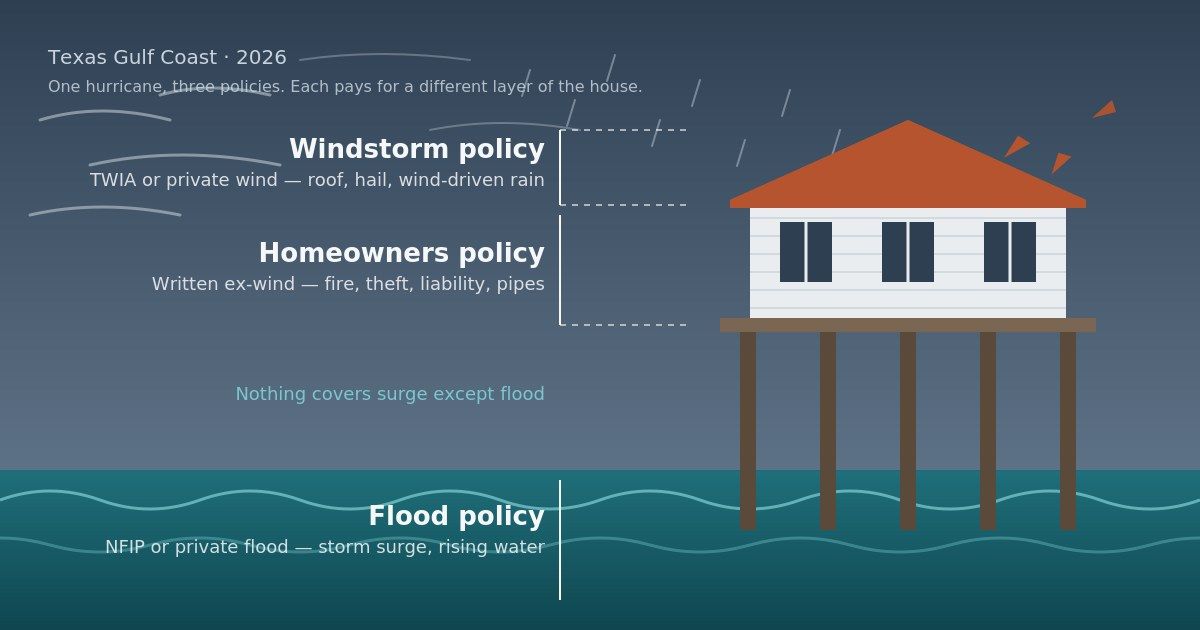
Every homeowner in Texas City, Galveston, La Marque, Dickinson and the rest of the coast eventually learns the same lesson, and most learn it the expensive way: a hurricane is not one insurance event. It is three or four, split across separate policies, each with its own deductible, its own carrier, and its own adjuster.
Fifty miles inland, one homeowners policy absorbs nearly everything a storm can do. Down here, it does not. Carriers writing coastal property have excluded wind and hail for decades because of hurricane exposure, which means the single most likely source of damage to your home is carved out of the policy you assume protects it.
That is the gap this article is about — and the good news is that the old three-policy scramble is no longer your only option.
What wind and storms actually damage, and who pays for it
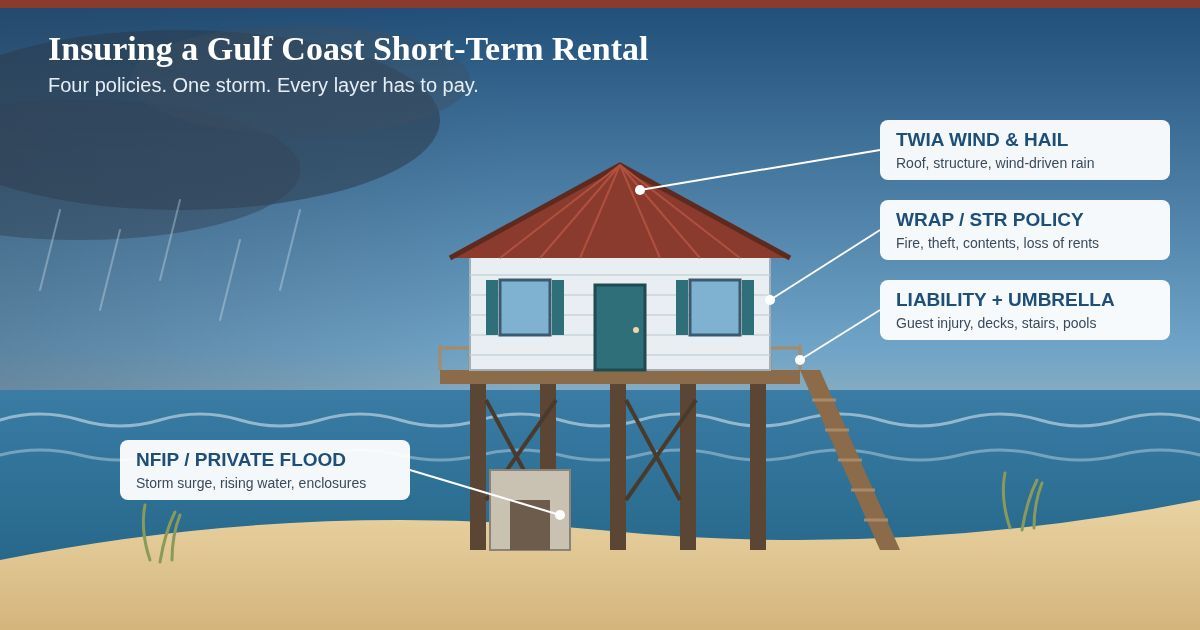
Before comparing your options, it helps to see how a single hurricane gets divided up:
| Type of damage | Which policy pays | Typical deductible |
|---|---|---|
| Wind and hail | TWIA, a private windstorm policy, or a windstorm-included home policy | Percentage of dwelling limit, usually 1%–5% |
| Storm surge, rising water, flooding from rainfall | NFIP or private flood policy | Flat dollar, commonly $1,000–$10,000 |
| Fire, theft, liability, interior water damage | Homeowners policy | Flat dollar, often $1,000–$5,000 |
| Rain through an opening the wind created | Your wind coverage | Wind deductible applies |
| Rain through an opening the wind did not create | Usually nobody — commonly excluded | N/A |
Miss any one layer and you have an uninsured hurricane. That is the single most useful thing to understand about wind and storms on the Texas Gulf Coast.
Your three routes to windstorm coverage
1. TWIA — the residual market
The Texas Windstorm Insurance Association is a not-for-profit insurer of last resort. It provides wind and hail coverage to property owners who cannot get it in the private market, across the 14 first-tier coastal counties plus the portion of Harris County east of Highway 146.
To qualify, the property must sit in the designated catastrophe area, the applicant must have been declined by at least one authorized insurer, the structure must be certified to applicable building codes with limited exceptions, and flood insurance must be in force where it is required.
The catch: TWIA is wind and hail only. It is not a homeowners policy. Every TWIA policyholder needs a companion "wraparound" home policy that excludes wind — two policies, two carriers, two bills, and after a storm, two separate claims that can disagree about what caused what.
2. A private windstorm policy
Private carriers do write wind and hail on the Texas coast, and for many properties the terms compare favorably to the residual market — particularly newer homes and those with modern roof systems, impact-rated openings, or hurricane straps, which frequently earn construction credits that TWIA's rating structure does not reward the same way.
A private windstorm policy still sits alongside a separate wraparound home policy, so the two-policy structure remains. What changes is who you are insured with, how your claim gets handled, and often what you pay.
3. A windstorm-included home policy — one policy, wind covered
This is the option most coastal homeowners do not know exists, and it is the one we built this agency's practice around.
Instead of buying a home policy that excludes wind and then bolting a windstorm policy onto it, a windstorm-included home policy covers wind and hail inside the homeowners form itself. One carrier. One policy. One adjuster after the storm.
The practical difference shows up at claim time. In the two-policy structure, a wind claim and a non-wind claim can land with two different companies, and the homeowner ends up in the middle of a causation argument about which peril did which damage. With wind included on a single form, that argument largely disappears.
Eligibility and availability vary by property, construction, location and carrier appetite. [BRAD — insert your current eligibility notes here: which carriers, which counties, typical dwelling-limit range, roof-age requirements. Being specific here is what will make this section rank and convert.]
Comparing your three options side by side
| TWIA + wraparound | Private windstorm + wraparound | Windstorm-included home policy | |
|---|---|---|---|
| Number of policies | Two | Two | One |
| Wind & hail covered | Yes | Yes | Yes |
| Fire, theft, liability | On the wraparound | On the wraparound | Same policy |
| Flood covered | No — buy separately | No — buy separately | No — buy separately |
| Claims after a storm | Two carriers, two adjusters | Two carriers, two adjusters | One carrier, one adjuster |
| WPI-8 required | Yes, with limited exceptions | Varies by carrier | Varies by carrier |
| Credits for newer construction | Limited | Often available | Often available |
| Best suited to | Properties declined elsewhere | Homes that qualify on construction | Homeowners who want one policy and one claim |
There is no universally correct answer here. The right structure depends on your property's construction, age, roof, location and certification status — which is exactly what a coverage review is for.
Percentage deductibles: the number most homeowners get wrong
Wind deductibles are not flat dollar amounts. They are a percentage of your Coverage A dwelling limit.
Worked example. A home insured for $400,000 with a 2% wind deductible carries an $8,000 out-of-pocket obligation before the policy responds. At 5%, that same home carries $20,000.
Two consequences follow:
- Deductible choice is your largest premium lever. Moving between tiers can swing a coastal wind premium substantially. That savings is real — but it is money you are agreeing to carry yourself at the worst possible moment.
- Your deductible grows when your dwelling limit does. Inflation-adjustment endorsements raise Coverage A automatically at renewal, which is correct and necessary. But your dollar deductible rises right along with it, quietly, without a phone call.
Ask yourself one question before choosing a tier: could I write that check within a week of a hurricane, when contractors are scarce and prices are climbing? If not, buy the lower deductible.
The WPI-8 certificate: the paperwork that stalls coastal applications
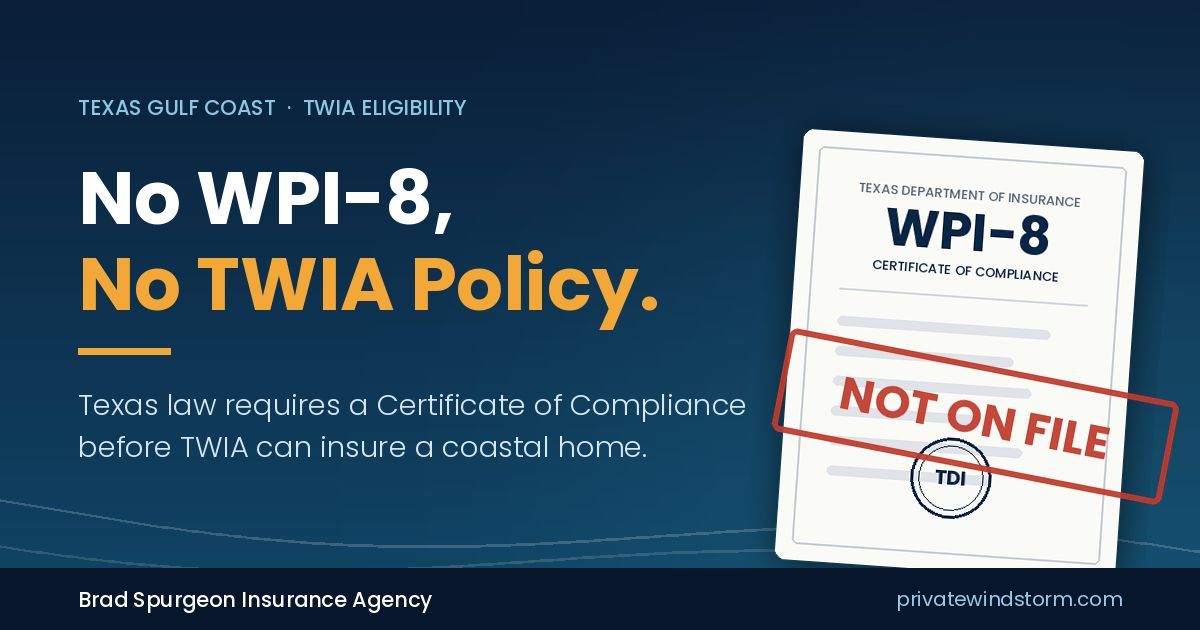
The WPI-8 is the windstorm building-code certification issued after an inspection confirms a structure meets applicable coastal building standards. Missing or outdated WPI-8 documentation is one of the most common reasons a coastal application stalls — and it becomes a serious problem when a homeowner tries to bind coverage in August.
If you have added a roof, replaced windows, or built an addition since your last certificate, your WPI-8 may no longer cover the whole structure. Our walks through what the certificate is, when you need a new one, and how to get one.
Flood is separate — no matter which route you choose
This is the largest and most expensive misunderstanding in coastal insurance, so it is worth stating plainly: none of the three options above cover flood. Not TWIA, not a private windstorm policy, not a windstorm-included home policy.
Wind damage is caused by air pressure and debris — a lifted roof, broken windows, downed trees. Flood damage is caused by water rising from the ground up, including storm surge. They are different perils on different policies with different deductibles, and the distinction determines who pays.
A meaningful share of NFIP claims come from properties outside high-risk mapped zones. Every property is in a flood zone; some are simply rated lower risk. If you are inland of the surge line and skipping flood coverage because of your zone designation, you are making a bet on the map rather than on the weather.
Timing is coverage: the deadlines that decide whether you are protected
- Hurricane season runs June 1 through November 30. The Gulf's most active stretch is mid-August through October.
- New NFIP flood policies carry a 30-day waiting period in most circumstances, with narrow exceptions such as a policy purchased in connection with a loan closing. A policy bought as a storm approaches will not respond to that storm.
- Binding suspends when a named storm enters the Gulf. TWIA and private carriers stop writing new business and stop increasing limits once a system is in the box. Underwriting can freeze for a week or more.
- Report claims promptly. TWIA generally requires notice of claim within one year of the date of loss, with separate, shorter deadlines for demanding appraisal or filing suit. Private carriers set their own.
The practical rule: make coverage decisions in the spring, not in the cone. By the time a storm has a name, your options are whatever you bought in April.
Your pre-season coverage review: seven checks
- Confirm the wind exclusion. Pull up your homeowners declarations page and search for the words windstorm, hail, or exclusion endorsement. If they are there, your wind coverage lives somewhere else — or nowhere.
- Verify your wind coverage is in force and that the named insured, mortgagee and mailing address are all current.
- Check Coverage A against today's rebuild cost — not market value, not your tax appraisal. Coastal labor and materials have moved sharply.
- Calculate your wind deductible in dollars. Multiply Coverage A by your percentage. Write the number down.
- Confirm replacement cost, not actual cash value, on both dwelling and contents. ACV settlement on a 15-year-old roof after a hurricane is a brutal surprise.
- Buy flood coverage even outside a mapped high-risk zone.
- Photograph everything now — roof, all four elevations, interior room by room, serial numbers on major items. Date-stamped pre-storm documentation is the strongest answer to a pre-existing damage argument.
Frequently asked questions
Does my homeowners insurance cover wind and storms in coastal Texas?
Usually not. Homeowners policies written in the designated catastrophe area typically carry a windstorm and hail exclusion. Wind and hail damage is covered by TWIA, a private windstorm policy, or a home policy written with windstorm included.
What is a windstorm-included home policy?
It is a homeowners policy that covers wind and hail inside the policy itself rather than excluding it. Instead of carrying a separate windstorm policy alongside a wraparound home policy, you have one policy, one carrier, and one adjuster after a storm.
Is private windstorm insurance better than TWIA?
It depends on the property. Private carriers often give credit for newer construction, updated roofs and impact-rated openings, which can produce better pricing or terms. TWIA exists specifically for properties that cannot get coverage in the private market. The only way to know which is better for your home is to compare both.
What is the difference between wind damage and flood damage?
Wind damage is caused by air pressure and debris — a lifted roof, broken windows, downed trees. Flood damage is caused by water rising from the ground up, including storm surge. They are covered by different policies with different deductibles.
Do I need flood insurance if I am not in a flood zone?
Every property is in a flood zone; some are simply rated lower risk. Flood is excluded from every home and wind policy, so without a separate flood policy that damage is uninsured regardless of what the map says.
Can I buy windstorm insurance right before a hurricane?
No. Carriers suspend binding once a named storm enters the Gulf, and new flood policies carry a 30-day waiting period. Coverage has to be in place well before a system forms.
How much is my windstorm deductible?
Multiply your Coverage A dwelling limit by your deductible percentage. On a $400,000 dwelling limit with a 2% deductible, that is $8,000.
Do I need a WPI-8 certificate?
For TWIA, yes, with limited exceptions. For private and windstorm-included policies, requirements vary by carrier. If you have replaced a roof or added on since your last certificate, it may need to be updated either way.
Have your coverage read before the next storm — not after
Most coastal claim disputes are not really claim disputes. They are policy-structure problems that were visible on the declarations page months earlier: a dwelling limit that never kept up with rebuild costs, an actual cash value settlement nobody flagged, a flood policy nobody bought, a WPI-8 that stopped matching the house three renovations ago.
We have been reading coastal policies from our Texas City office since 1986, three generations in. We will compare TWIA, private windstorm and windstorm-included options side by side for your specific property and show you what each one actually does at claim time.
Call (409) 945-4746 | https://www.privatewindstorm.com/
Brad Spurgeon Insurance Agency Inc. · 1118 14th Street North, Texas City, TX 77590 · brad@bradspurgeonins.com
Serving Texas City, La Marque, Dickinson, Hitchcock, Santa Fe, League City, Kemah, Bacliff, San Leon, Galveston Island, Bolivar Peninsula, Crystal Beach, Lago Mar subdivision, Friendswood, Port Aransas, Alvin and communities across the Texas Gulf Coast.
This article is general information about insurance concepts in Texas and is not a policy, a contract, or a promise of coverage. Coverage terms, limits, exclusions, eligibility and availability vary by policy, carrier and property, and only your policy language and the carrier's determination control. Verify current TWIA rules and limits at twia.org and current flood program rules at floodsmart.gov. Brad Spurgeon Insurance Agency Inc., Texas City, Texas.