How to choose homeowners insurance on the Texas Gulf Coast: what to check before hurricane season

A homeowner in Texas City had been paying her homeowners insurance premiums faithfully for years. When a named storm rolled through Galveston County and tore shingles off her roof, she filed her claim confident her policy had her back. What she didn't know, and what nobody had told her, was that windstorm damage had been quietly excluded from her standard policy. The payout she expected? It wasn't coming.
That conversation, the one that happens after a hurricane instead of before it, is exactly what we work to prevent at Brad Spurgeon Insurance Agency Inc. We're a family agency that has been serving Texas City and the Gulf Coast for decades, and we've seen this scenario more times than we'd like. The good news: once you understand how homeowners insurance actually works on the coast, protecting yourself completely is straightforward. This article walks you through what's covered, what's not, and the specific steps to get fully protected before hurricane season starts.
What a standard homeowners insurance (HO-3) policy covers
Before you can spot the gaps, you need a clear picture of the baseline. A standard HO-3 policy, the most common form of home insurance in the country, organizes coverage into six sections. Understanding each one in plain terms makes everything else in this article land with the impact it deserves.
The six coverages in an HO-3 policy
Coverage A is your dwelling: the walls, roof, built-in appliances, plumbing, and electrical systems of your home. This is covered on an open-perils basis, meaning the policy pays for damage from any cause that isn't specifically excluded. Coverage B handles other structures on your property, like a detached garage or a fence, typically up to 10% of your dwelling limit. Coverage C covers your personal belongings, but here's where it shifts: personal property is named-perils only, meaning it's covered solely for causes of loss that are specifically listed in the policy.
Coverage D, loss of use, pays for temporary housing and reasonable extra living expenses if your home becomes uninhabitable after a covered loss, think hotel stays and meals while your roof gets repaired after a storm. Coverage E is personal liability, which covers legal defense and damages if someone is injured on your property and holds you responsible. Coverage F pays limited medical expenses for guests injured at your home, generally without requiring any fault determination on your part.
Replacement cost vs. actual cash value: the difference is real money
One of the most consequential choices in your homeowners insurance policy is whether your coverage pays at replacement cost value or actual cash value. Replacement cost value, often called RCV, pays what it actually costs to repair or replace your property today without subtracting for depreciation. Actual cash value, or ACV, deducts depreciation based on age, wear, and expected useful life before cutting you a check.
Here's a concrete example that matters especially on the Gulf Coast: a 10-year-old roof that costs $15,000 to replace today might generate only a $6,000 payout under an ACV policy after the insurer applies depreciation. Given that Gulf Coast storms can force a roof replacement every several years, that gap comes directly out of your pocket. Texas homeowners already pay an average of around $4,800 annually for a $300,000 dwelling-coverage policy, making it one of the priciest states in the country (based on 2026 national premium data). That cost makes it even more critical to get the coverage right, not just the premium low.
Homeowners insurance gaps on the Texas Gulf Coast
This is where the Texas City homeowner in our opening story got caught. Standard HO-3 policies have exclusions that are routine everywhere but feel especially painful on the Gulf Coast, where the risks they exclude are also the most likely ones to show up on your doorstep.
Windstorm and hail: standard exclusions in coastal Texas
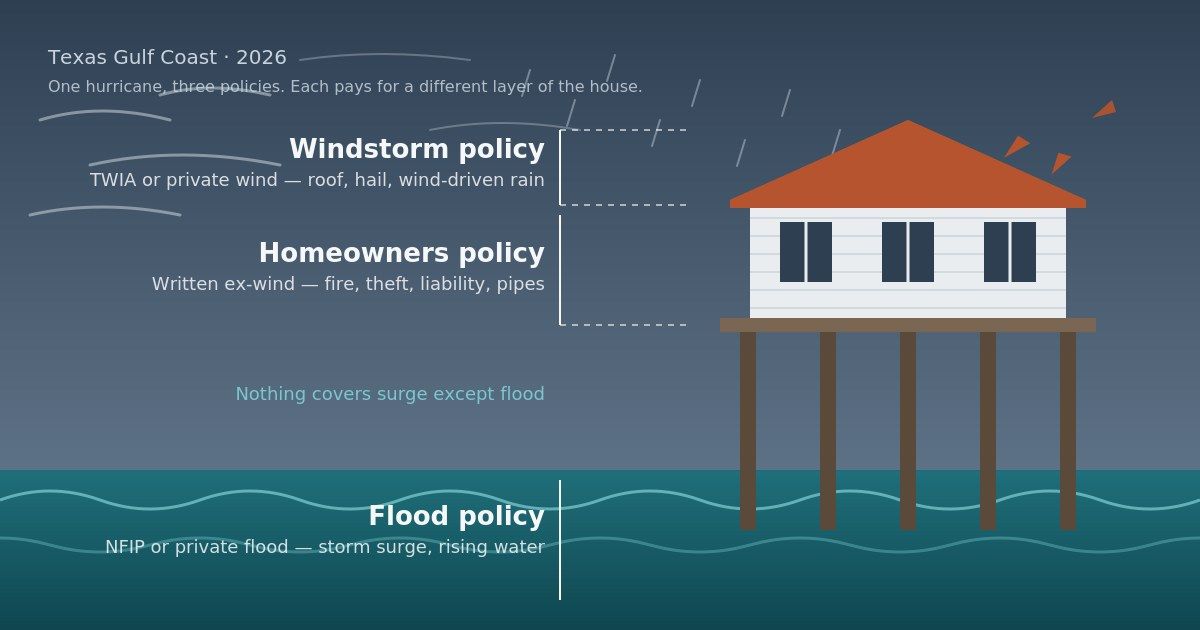
Many homeowners in Gulf Coast counties are surprised to learn that their standard homeowners insurance excludes windstorm and hail damage entirely. This isn't a company quirk or a fine-print trick. In Texas coastal counties, insurers routinely exclude these perils from the base policy because hurricane exposure makes them too costly to bundle into standard pricing. It's a regulatory and actuarial reality for anyone living in a high-risk coastal zone.
The practical implication is stark: your standard home insurance deductible doesn't even apply to windstorm damage, because the peril isn't covered at all. Without a separate windstorm policy or endorsement, a hurricane tearing your roof apart generates exactly zero dollars from your standard homeowners policy. That's the gap that catches people off guard every single storm season.
Flood damage: the exclusion that stings the most after a hurricane
Flood damage is excluded from every standard homeowners policy in the country, no exceptions. Storm surge, rising bayous, and heavy rain that overwhelms drainage systems are not covered, regardless of your insurer or your policy's other terms. For Texas City homeowners, this isn't a theoretical risk. The area sits in and near designated FEMA flood zones, including AE, VE, and other Special Flood Hazard Areas where even moderate storms push water into neighborhoods.
Flood insurance requires a separate policy entirely, typically through the National Flood Insurance Program (NFIP) or a private flood carrier. According to FEMA, NFIP policies generally cover up to $250,000 for the building and $100,000 for contents. There's also a timing issue that catches people every year: most flood policies carry a 30-day waiting period before coverage takes effect, though exceptions may apply in certain escrow, closing, or flood-map-change situations. Buying a policy the week before a named storm enters the Gulf isn't a strategy. It's too late.
Your options for complete coastal coverage compared
Once you understand the gaps, the next question is how to close them. Gulf Coast homeowners generally have two main approaches, and they differ significantly in simplicity and local fit.
Going the separate-policy route: more moving parts than most expect
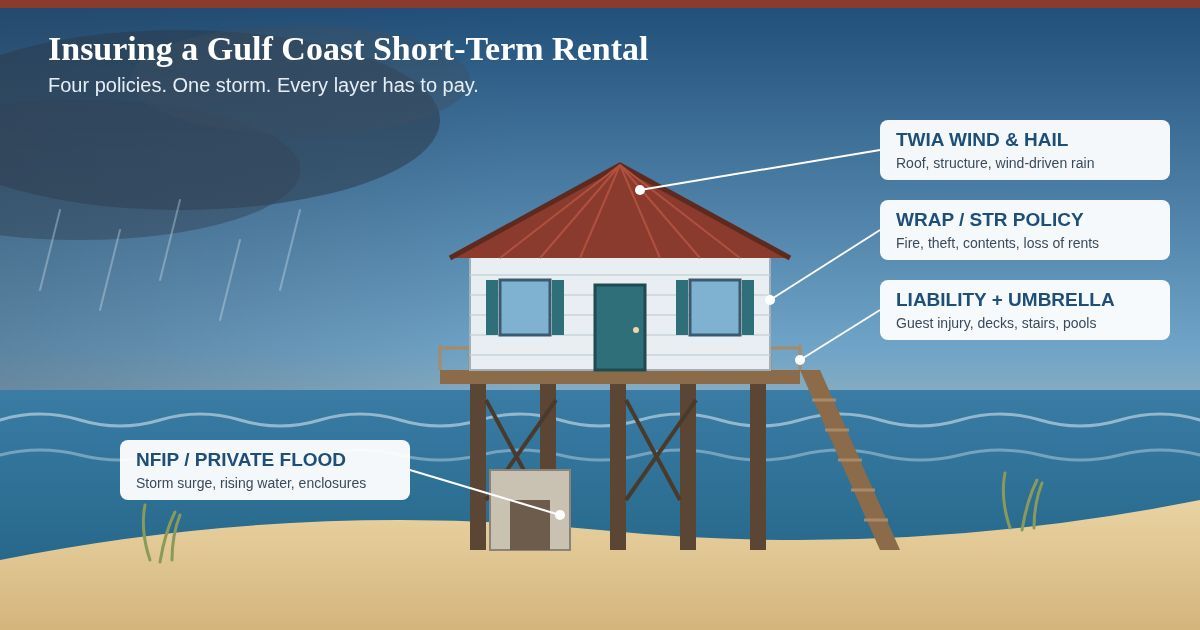
The traditional approach is to carry three separate policies: a standard homeowners policy for fire, theft, liability, and non-wind perils; a windstorm and hail policy, often through TWIA (the Texas Windstorm Insurance Association); and a separate flood policy through NFIP or a private carrier. TWIA is Texas's insurer of last resort for windstorm and hail in designated coastal counties, including Galveston. According to the Texas Department of Insurance, TWIA eligibility generally requires a private-market declination plus a Texas windstorm certificate of compliance for the home.
This approach works, but it comes with real coordination demands. Each policy has its own premium, renewal date, deductible, and claims process. After a major hurricane, when you may be dealing with wind damage, water intrusion, and flooding all at once, you're filing with three separate insurers, each with their own adjusters, timelines, and coverage interpretations. The seams between policies become your problem to manage at exactly the moment you have the least capacity to manage anything.
The Windstorm Included Home Policy: one policy built for the Gulf Coast
Brad Spurgeon Insurance Agency Inc. offers a Windstorm Included Home Policy that bundles windstorm coverage directly into a standard home policy, designed specifically for Gulf Coast homeowners who want one policy, one renewal date, and one point of contact when filing a claim. Instead of coordinating between multiple insurers after a storm, you're working with a single local agency that understands how coverage needs to fit together on the coast.
For homeowners who want simplicity without sacrificing protection, this is the cleaner path. Deep local expertise matters when claims get complicated, when adjusters need neighborhood context, and when you need someone who knows your policy inside and out. That's a meaningful difference from managing three separate policies with three separate companies that may have no familiarity with Galveston County at all.
How to set the right coverage limits and deductible
Getting the right policy type is half the job. Setting the right numbers on your declarations page is the other half, and this is where many homeowners quietly underinsure themselves.
Insuring to rebuild cost, not market value
Your dwelling coverage, Coverage A, should reflect what it costs to rebuild your home from the ground up: local labor rates, current material prices, and any building code upgrades required by today's standards. This number has nothing to do with what you paid for the home or what it would sell for on the market. In Gulf Coast Texas markets, post-hurricane contractor demand can push rebuild costs up sharply, which makes setting this number accurately even more important.
Watch for the 80% coinsurance rule: if your coverage limit falls below the insurer's required percentage of your home's rebuild cost, you may not receive a full payout even on a partial loss. Extended or guaranteed replacement cost endorsements protect against rebuild-cost inflation by covering amounts above your stated dwelling limit. For a coastal home where storm-related rebuilding demand can spike quickly, get this endorsement, it's especially valuable on the Gulf Coast.
Wind and flood deductibles: what the percentage actually means
Coastal homeowners commonly carry a wind and hail deductible expressed as a percentage of the dwelling limit rather than a flat dollar amount. In coastal Texas, that percentage typically runs 1% to 5%, with 2% being common and higher percentages appearing in the most exposed zones. On a $300,000 dwelling limit, a 2% wind deductible means $6,000 out of your pocket before coverage applies. On a $400,000 limit, that same 2% becomes $8,000.
Pull your current declarations page and find this number. It's expressed as a percentage next to terms like "wind," "hail," "hurricane," or "named storm." Flood policies carry their own separate deductible structure on top of this. Understanding both numbers before a storm hits lets you make a real decision about whether your emergency savings align with your deductible exposure, rather than discovering the mismatch during a claim.
What to do before hurricane season arrives
Knowing what you need and actually having it set up are two different things. The steps below are specific, actionable, and much easier to complete before a storm is named than after one is forecast.
Home inspections, mitigation credits, and roof age
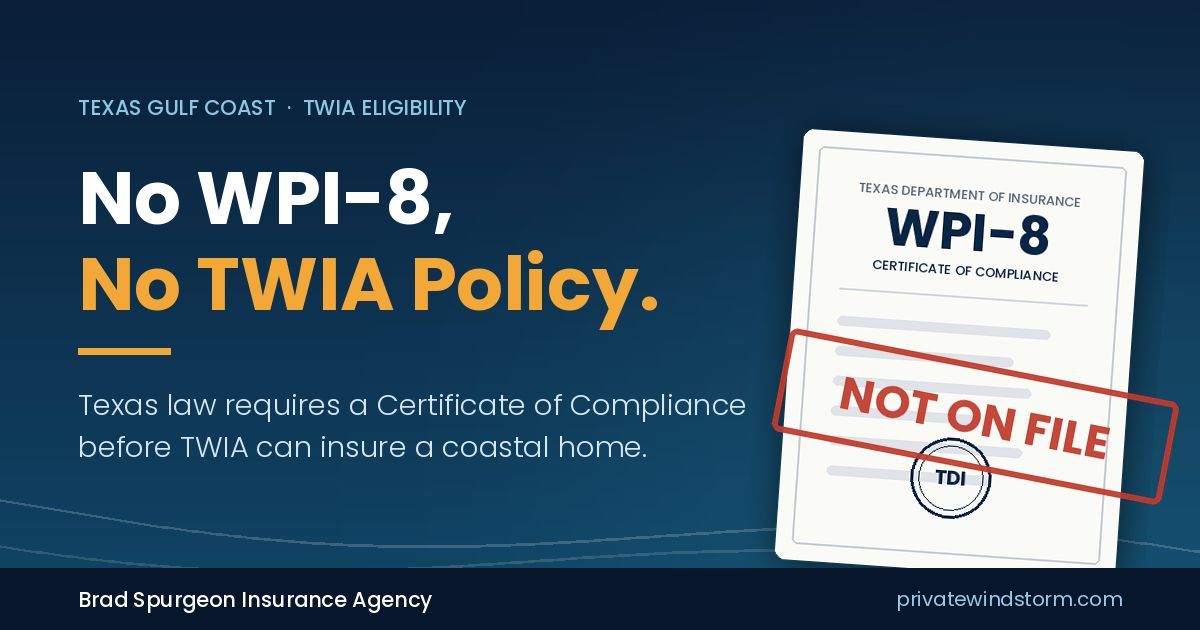
Texas coastal homeowners can qualify for windstorm mitigation discounts by having a windstorm inspection done on their property. Features like hurricane straps, impact-resistant windows, reinforced roof decking, and wind-rated garage doors can lower premiums when verified through an inspection. A passing inspection results in a Certificate of Compliance from the Texas Department of Insurance, commonly called a WPI-8, which is also required for TWIA eligibility on most post-1987 construction.
Roof age is one of the factors insurers weigh most heavily. A roof over 15 to 20 years old often triggers coverage restrictions, higher rates, or ACV settlement terms on roof claims rather than replacement cost. Getting a windstorm inspection done, addressing obvious vulnerabilities, and knowing your roof's status before the season starts puts you in a stronger underwriting position and opens the door to mitigation credits that can meaningfully offset your homeowners insurance rates.
Using Brad Spurgeon's online tools to review and manage your policy
Brad Spurgeon Insurance Agency Inc. makes it easy for Gulf Coast homeowners to stay on top of their coverage year-round. Through the agency's online platform, you can make payments, report claims, access policy documents, and schedule a consultation without waiting on hold. Before hurricane season, use those tools to pull your declarations page, confirm your dwelling coverage limit reflects current rebuild costs, and check your deductible percentages for wind and flood.
If anything looks off or incomplete, requesting a personalized home insurance quote or a coverage review takes just a few minutes online and gets experienced local eyes on your policy. That review might reveal you're underinsured on Coverage A, carrying an ACV roof settlement clause you didn't know about, or missing flood coverage for a property in an AE zone. Small discoveries before the season starts can mean the difference between a covered claim and a very difficult conversation.
Homeowners insurance FAQs for Gulf Coast Texans
Does a standard homeowners insurance policy cover hurricane damage?
Not fully. A standard HO-3 policy covers many perils but typically excludes windstorm, hail, and flood damage in Texas coastal counties. You'll need separate windstorm and flood coverage to be fully protected against a hurricane's most common and costly hazards.
What is a wind deductible and how does it work?
A wind deductible is a separate, often percentage-based deductible that applies specifically to wind and hail claims. On the Texas Gulf Coast, it typically runs 1% to 5% of your dwelling coverage limit. On a $300,000 home with a 2% wind deductible, you'd owe $6,000 before your policy pays anything for wind damage.
When should I buy flood insurance?
As early as possible, and well before storm season. Most NFIP flood policies carry a 30-day waiting period before coverage activates. If a named storm is already in the Gulf, it's too late to get a new flood policy in place in time. Don't wait for a forecast to prompt the purchase.
What is the WPI-8 certificate and do I need one?
The WPI-8 is a Certificate of Compliance issued by the Texas Department of Insurance after a passing windstorm inspection. It documents that your home meets construction standards for wind resistance. For most post-1987 construction, it's required to qualify for TWIA windstorm coverage and can also unlock mitigation discounts on your homeowners insurance rates.
You know the gaps now. Closing them is the easy part.
The Gulf Coast is a genuinely beautiful place to own a home. The risks are real, but they're manageable once you understand them. A standard homeowners insurance policy isn't designed to carry all of the risks coastal Texas presents, that's not a flaw in the system so much as a gap you can close deliberately with the right coverage choices.
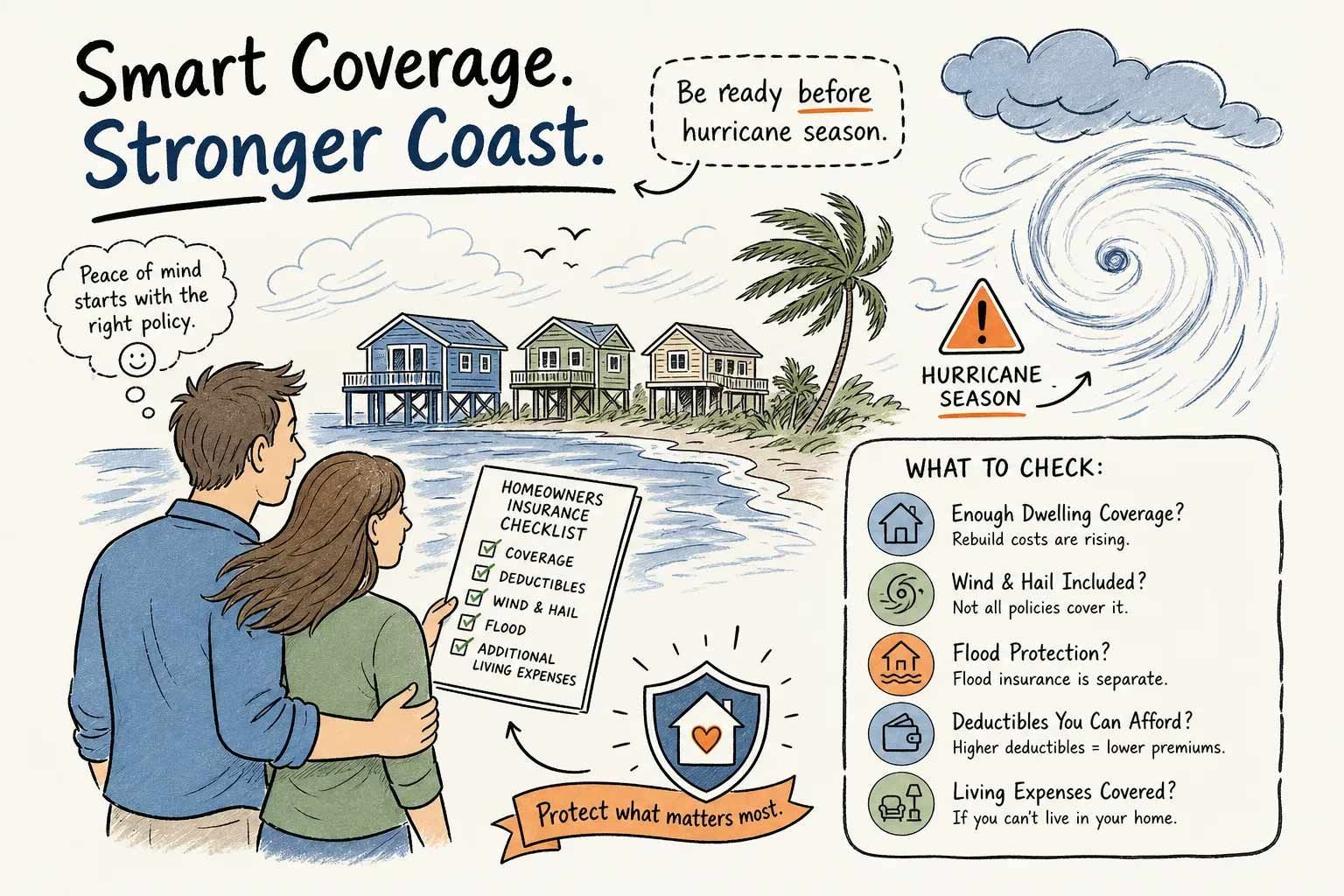
Here's the short version of what to act on: understand what your HO-3 covers and what it excludes, decide how you'll cover windstorm and flood before the season starts, set your dwelling limit to actual rebuild cost, review your deductible percentages, and check whether your roof age creates any coverage limitations. For homeowners who want to skip the three-policy juggling act, the Windstorm Included Home Policy from Brad Spurgeon Insurance Agency Inc. is a straightforward, locally built solution backed by years of Gulf Coast experience.
Don't wait for a post-hurricane conversation to discover the gap in your homeowners insurance. Reach out to our team before the season hits, request a personalized quote, or schedule a consultation through our online platform. A little clarity now is worth an enormous amount after a storm.