Top questions to ask your insurance agent before buying coastal home insurance

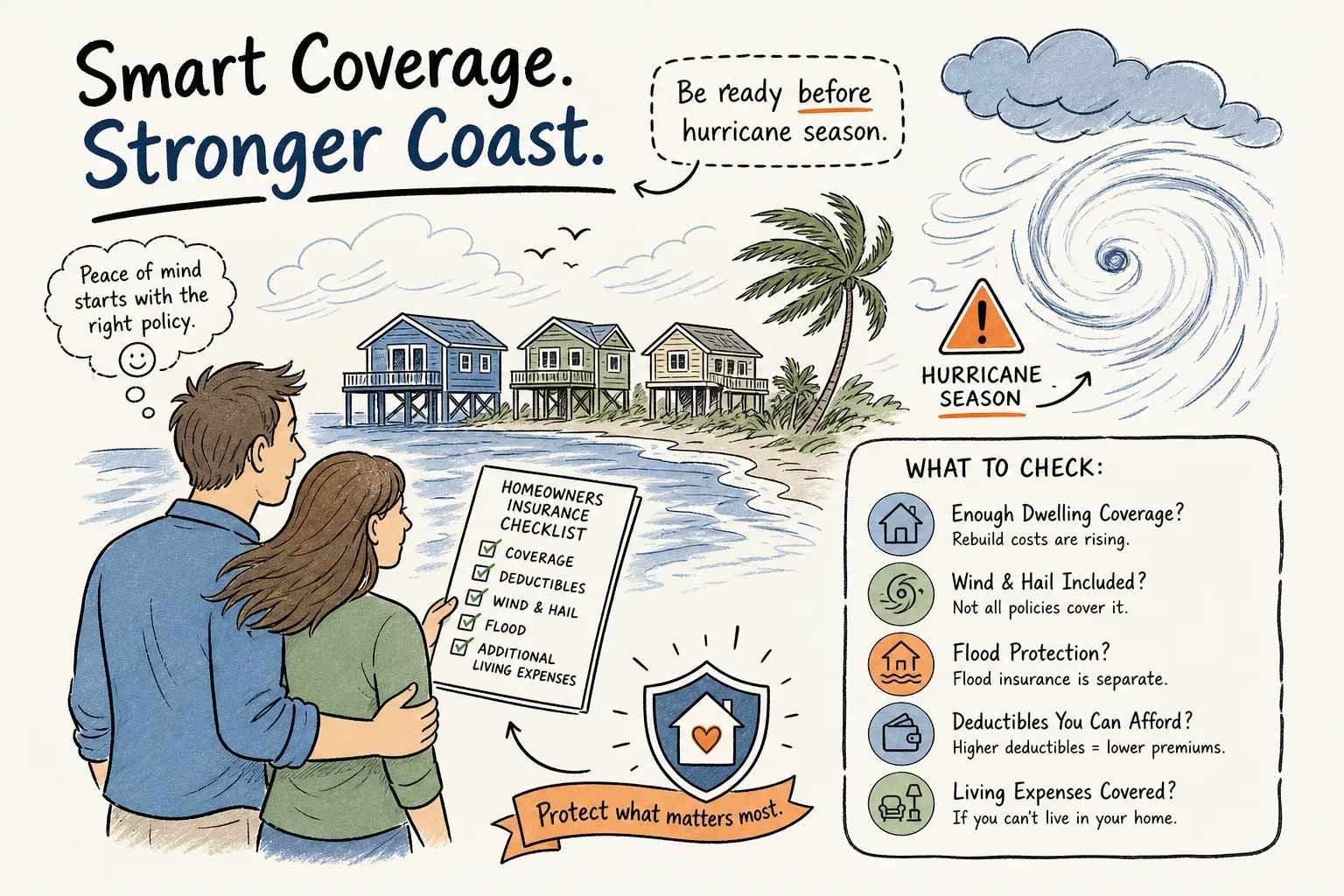
What are the most important questions to ask an insurance agent before buying coastal home insurance? Most buyers never think to ask them until after a storm. Many coastal homebuyers report spending more time negotiating kitchen countertops than understanding their insurance policy. That's a reasonable way to live, until a named storm makes landfall and the claim comes back short of what you needed. The policy was there. The coverage wasn't.
Wind excluded. Flood not purchased. Deductible never translated into a real dollar amount. The policy looked fine on paper. In practice, it had gaps a storm could drive a boat through.
This article gives you the questions that change that. Six categories. Each one designed to reveal whether the agent in front of you truly understands Gulf Coast exposure, or is simply filling in a form.
What your base policy actually covers, and what it doesn't
The standard exclusions that surprise coastal buyers the most
A standard homeowners policy typically excludes two of the most dangerous coastal perils: flood damage and, in many high-risk zones, windstorm or hurricane damage. Storm surge, the wall of water that often causes the most destruction in a hurricane, falls under flood coverage, not wind. These are not minor footnotes. They are the primary ways Gulf Coast homes get destroyed.
Ask your agent, point-blank, which perils are explicitly excluded from the base policy and which require a separate policy or endorsement. A good answer names both flood and wind clearly, explains what triggers each gap, and doesn't leave you guessing. A concerning answer hedges, or assumes you don't need to know the details until after you sign.
Replacement cost vs. actual cash value: why it matters more on the coast
Replacement cost coverage pays to rebuild at today's prices. Actual cash value subtracts depreciation from that figure first. On the Gulf Coast, where construction costs spike sharply after a major storm, the difference between the two can be significant.
Ask the agent whether the dwelling, personal property, and other structures are each covered on a replacement cost or actual cash value basis. These are separate line items in the policy and don't always receive the same treatment. A vague answer about which applies where is a warning sign worth paying attention to.
Questions to ask an insurance agent before buying coastal home insurance: windstorm and hurricane
How named-storm deductible triggers work, and when yours kicks in
Hurricane and named-storm deductibles are calculated as a percentage of your dwelling coverage limit, not a flat dollar amount. On the Texas Gulf Coast in 2026, windstorm deductibles typically range from 1% to 5%, with some higher-risk coastal properties reaching 10% to 15%, according to the Texas Department of Insurance.
Ask what specifically triggers the deductible. Does it require an official hurricane designation, or does a named tropical storm qualify too? Ask whether the deductible applies per storm, per season, or per policy year. Ask what happens if your loss occurs before landfall or after the storm is downgraded. These aren't hypothetical edge cases. They're the exact scenarios that generate claim disputes. An agent who can't explain the trigger clearly is not the right agent for a coastal property.
How a bundled windstorm policy closes the gap for Gulf Coast homeowners
Piecing together a base homeowners policy plus a separate windstorm policy creates real friction: two policies, two deductibles, two insurers to negotiate with after a storm. When wind and flood damage overlap, as they often do in a hurricane, the question of which insurer covers what becomes a source of delay and dispute.
Brad Spurgeon Insurance Agency Inc. offers a Windstorm Included Home Policy, a single home policy that bundles windstorm coverage directly into the package for Gulf Coast properties. Ask any agent whether they offer a comparable all-in-one solution or whether wind is handled separately. The answer tells you a great deal about how complicated your post-storm claims experience is likely to be.
Flood exposure questions you can't afford to skip
NFIP vs. private flood insurance: which one fits your property
Flood coverage is never included in a standard homeowners policy. It must be purchased separately, either through the National Flood Insurance Program (NFIP) or a private flood insurer. These are two distinct options with different limits, pricing structures, and underwriting rules, and the right agent should walk you through both.
Ask whether the property sits in a FEMA-designated high-risk flood zone and whether a federally backed mortgage legally requires flood coverage. Then ask whether private flood insurance might offer higher limits or better terms for the specific property. According to the National Flood Insurance Program, federal law generally requires flood insurance when a property securing a federally regulated or federally backed mortgage is in a FEMA-designated high-risk flood area. The right agency runs both options and explains the trade-offs rather than defaulting to one without comparison.
How an elevation certificate affects your flood premium, and how to get one
An elevation certificate is a document prepared by a licensed surveyor that records the building's elevation relative to the Base Flood Elevation (BFE). In FEMA high-risk flood zones, particularly Zone A and Zone V on the Texas Gulf Coast, the higher your lowest floor sits above the BFE, the lower your flood risk and often your premium. Per FEMA and NFIP guidance, agents and property owners may use an elevation certificate to obtain a more accurate NFIP premium, and providing one before quoting can meaningfully affect the rate.
Ask the agent whether an existing elevation certificate is on file for the property and whether obtaining or updating one could reduce the flood insurance quote. That certificate should be requested before quoting, not after. If none exists, a state-licensed land surveyor, professional engineer, or certified architect can prepare one. Check with the city or county building or permitting office first, as a certificate may already be on file from the original construction.
Deductibles, real dollar exposure, and the endorsements most buyers miss
Translating percentage deductibles into actual dollar amounts
Always ask the agent to express percentage deductibles as dollar figures against the actual dwelling limit. A 2% deductible sounds manageable in the abstract.
Ask whether the hurricane deductible and the all-other-perils deductible apply separately or together on a single storm claim. Ask whether multiple named storms in one season could trigger multiple deductibles. The right agent walks through these numbers on the quote with actual dollar figures, not just the percentage and the premium line.
Ordinance and law coverage: the endorsement coastal buyers rarely think to ask about
If a storm damages more than a set percentage of an older home, local building codes may require the entire structure to be demolished and rebuilt to current standards. That means current hurricane- resistance requirements, current floodplain elevation requirements, updated electrical and structural systems. None of that extra cost is covered under a standard policy.
Standard policies typically include only 10% of the dwelling limit for ordinance and law costs. For an older coastal home, that is almost certainly not enough. Endorsements can increase this to 25% or higher, and for homes that are 20 or more years old, 25% is a reasonable floor. Ask the agent what ordinance and law limit is included in the current quote and whether an increase is recommended given the home's age and local coastal code requirements. This is one of the most commonly skipped questions, and it often carries the most expensive consequences.
How to evaluate an insurer's reliability before you commit
Financial strength ratings and what they actually tell you
Financial strength ratings from agencies such as A.M. Best or Demotech indicate whether an insurer can pay claims after a major catastrophe. On the Gulf Coast, where a single hurricane season can strain carriers with heavy regional concentration, this matters more than it does in other markets. A favorable rating means the company is financially capable of paying claims; it doesn't guarantee any particular claim is handled fairly.
Ask for the rating of the specific underwriting company named on the policy, not the parent company or brand. Smaller regional carriers may be rated by Demotech rather than A.M. Best, which is not inherently a problem, but you should know which rating applies to the actual entity on your policy. Ask the agent to explain what reinsurance the insurer carries for catastrophic events. A carrier that concentrates too much coastal exposure without adequate reinsurance is a risk you shouldn't have to take.
Complaint ratios and what happens after a storm hits
Financial strength alone doesn't tell the whole story. State insurance department complaint ratios reveal how often policyholders dispute claim denials, delays, or underpayments. The NAIC's complaint database and the Texas Department of Insurance's open-data portal both provide complaint indices by insurer and line of coverage. A complaint ratio above 1.00 generally indicates the insurer generated a larger share of complaints than its share of comparable business.
Ask the agent for the insurer's state complaint index for homeowners or wind-related claims, and ask whether the company uses staff adjusters or independent catastrophe adjusters after a named storm. Ask how quickly claims are acknowledged and whether local adjusters are available after a major event. What you should hear back is honest, specific data. A concerning answer redirects to satisfaction scores instead of actual complaint and claims figures.
Mitigation discounts and how to meaningfully reduce your coastal premium
Wind mitigation inspections and the credits they unlock
Many coastal insurers offer premium discounts for homes with features that reduce wind damage: impact-resistant windows and doors, reinforced roof-to-wall connections, hip roofs, and rated garage doors. A wind mitigation inspection by a licensed inspector documents these features and can result in meaningful credits on the windstorm portion of the premium. For newer Gulf Coast homes built to current wind standards, those savings can be significant.
Ask the agent whether a wind mitigation inspection is worth doing on the property and which specific features the insurer credits. Not all mitigation features are valued equally by all insurers, so the answer should be specific to the policy being quoted. If the home already has impact windows or a reinforced roof, make sure those features are documented before the policy is bound.
Locking in the right coverage before you close
Treat the insurance conversation as a two-way evaluation. You're choosing the agent as much as the policy. An agent who can't clearly explain the hurricane deductible trigger, the flood exclusion, or the ordinance and law limit isn't the right partner for a Gulf Coast property purchase.
Brad Spurgeon Insurance Agency Inc. offers online tools to report claims, make payments, access documents, and schedule consultations. Whatever agent you work with, ask for a written summary of coverage inclusions, exclusions, deductibles, and endorsements before anything is bound, and confirm that deductible triggers are listed in dollar terms, not just percentages. Nothing should get lost between the quote conversation and the signed policy.
The questions that matter most aren't about price
The most important questions to ask an insurance agent before buying coastal home insurance aren't about finding the lowest premium. They're about what happens when a storm makes landfall and the claim is filed. A lower premium that leaves flood, wind, or ordinance costs exposed isn't savings. It's deferred risk, paid in full when the weather turns.
You now have a framework organized by topic, with questions that reveal whether an agent genuinely understands Gulf Coast exposure. Ask about the base policy exclusions and the deductible trigger, in writing, with dollar figures. Check on the elevation certificate and the ordinance and law limit. Confirm the complaint ratio and who shows up when catastrophe adjusters are needed. These aren't difficult questions. They're just the ones most buyers don't think to ask until after a storm.
If any of these questions left you uncertain after a recent insurance conversation, it may be time to speak with an agency that has been placing Gulf Coast coverage since 1986. Brad Spurgeon Insurance Agency Inc. can be reached online to book a consultation or request a review of an existing policy. Bring your declarations page and a list of questions. We'll work through them together.