Home Insurance Add-Ons: Which Additional Coverages May Be Worth Considering?

July 22, 2026

A standard homeowners policy provides an important foundation, but it may not address every risk associated with a particular property, location, or household. For homeowners in Texas City, TX, reviewing optional endorsements and separate policies can be especially important because coastal wind, flooding, rebuilding costs, valuable property, and aging home systems can create exposures beyond basic coverage.


Why Home Insurance Add-Ons Matter

Home insurance add-ons are endorsements, increased limits, or separate policies used to address losses that are excluded, restricted, or insufficiently covered by the standard policy.


The right additions depend on factors such as:

  • The home’s location and construction
  • Replacement and rebuilding costs
  • Valuable belongings
  • Flood and wind exposure
  • Plumbing and drainage systems
  • Home-based business activity
  • Aging appliances and equipment
  • The owner’s financial ability to absorb a loss


An add-on is worthwhile when the potential uninsured expense is meaningful and the coverage addresses a realistic exposure. It should not be purchased simply because it is available.


Windstorm and Hail Coverage

Homeowners along the Texas coast should verify whether their primary policy includes wind and hail damage. Some private insurers exclude these causes of loss or require a separate windstorm policy.


Windstorm insurance can cover qualifying damage caused by hurricanes, tornadoes, thunderstorms, hail, and other wind events. The Texas Department of Insurance advises residents to check how wind and hail are addressed because coverage availability depends on the property’s location and insurer.


When private-market wind coverage is unavailable, qualifying coastal property owners may obtain protection through the Texas Windstorm Insurance Association. TWIA serves designated areas that include all 14 first-tier coastal counties, including Galveston County.


Eligibility can require a Windstorm Certificate of Compliance showing that applicable construction or repair work meets windstorm building-code requirements.


Review:

  • Whether the dwelling and personal property are covered
  • The wind or hurricane deductible
  • Whether loss of use is included
  • Coverage for fences, sheds, and detached structures
  • Required inspections or certifications
  • Exclusions for certain exterior or cosmetic damage


Wind deductibles are often percentages of the dwelling limit rather than fixed dollar amounts. A 2% deductible on a home insured for $400,000 equals $8,000, so the percentage should be converted into dollars during the policy review.


Flood Insurance

Flood insurance is one of the most important separate coverages for many coastal homeowners. Standard homeowners insurance generally does not cover flooding caused by storm surge, overflowing waterways, or surface water entering the home.


Flood insurance may provide separate limits for:

  • The building
  • Foundation systems
  • Electrical and plumbing systems
  • Permanently installed equipment
  • Certain appliances
  • Personal belongings


Coverage may be available through the National Flood Insurance Program or a private flood insurer. Policy terms, limits, valuation methods, waiting periods, and additional living expense protection can differ.


A property does not need to be directly beside the water to experience flooding. Heavy rainfall, overwhelmed drainage, changing development patterns, and water collecting on normally dry land can all create flood losses.

Homeowners near the Texas City Dike or neighborhoods closer to Galveston Bay should compare the policy with the property’s elevation, flood zone, drainage, and mortgage requirements rather than relying solely on whether flood insurance is legally required.


Extended or Guaranteed Replacement Cost

Dwelling coverage should reflect the cost to rebuild the home, not its market value or the amount remaining on the mortgage.


Replacement cost coverage pays based on current repair or replacement prices without deducting ordinary depreciation, up to the policy’s applicable limit. Actual cash value coverage reduces payment based on age and condition.


Extended replacement cost can provide an additional percentage above the dwelling limit when rebuilding costs exceed the original estimate. For example, a policy with $350,000 in dwelling coverage and a 25% extension could potentially provide up to an additional $87,500, subject to the contract.


Guaranteed replacement cost, where available, may provide broader protection when the cost to rebuild exceeds the stated dwelling limit. Requirements may include accurate property information, inflation adjustments, and notice of major renovations.


This add-on may be valuable when:

  • Construction prices are volatile
  • Skilled labor is limited after a regional disaster
  • The home has custom features
  • Local rebuilding requirements have changed
  • The policy has not been updated after renovations


Ordinance or Law Coverage

A major claim may require the undamaged portions of a home to be upgraded to current building codes. Standard dwelling coverage may provide limited protection for these additional expenses.


Ordinance or law coverage may help pay for:

  • Demolition of undamaged sections
  • Updated electrical systems
  • New plumbing requirements
  • Improved structural connections
  • Energy-code upgrades
  • Permit-related rebuilding requirements


Suppose a fire damages half of an older home, but current code requires the entire electrical system to be replaced. The cost of repairing the direct fire damage and the cost of bringing the remaining system up to code may be treated differently.


Older homes and properties that have undergone multiple additions may need higher ordinance or law limits.


Water Backup Coverage

Home policies may cover sudden water damage from incidents such as a burst pipe or broken appliance hose, but water backing up through a sewer, drain, or sump system may require a separate endorsement. Texas insurance guidance distinguishes sudden accidental plumbing losses from excluded flood and gradual water damage.


Water backup coverage may apply when water enters through:

  • Floor drains
  • Sewer lines
  • Plumbing drains
  • Sump pump systems


This endorsement is not a substitute for flood insurance. Water crossing the ground and entering through a door, foundation opening, or wall is generally considered a flood exposure rather than a sewer-backup event.

Review the limit because cleanup, flooring replacement, drywall removal, electrical work, and damaged contents can exceed a small sublimit.


Scheduled Personal Property

Standard home policies often place special limits on valuables such as jewelry, watches, fine art, firearms, collectibles, silverware, and certain electronic or business property.


Texas insurance guidance notes that policies can limit payments for particular categories and recommends asking about additional coverage for valuable items and collectibles.


Scheduled personal property coverage may offer:

  • Higher item-specific limits
  • Broader causes of loss
  • Coverage for accidental loss
  • Reduced or no deductible
  • Agreed or appraised values


Recent appraisals, photographs, serial numbers, receipts, and ownership records may be required. A detailed home inventory can also help document property after a loss and reduce claim delays.


Equipment Breakdown Coverage

Equipment breakdown coverage may help with sudden mechanical, electrical, or pressure-system failures that ordinary home insurance excludes.


It may cover qualifying damage involving:

  • HVAC systems
  • Electrical panels
  • Water heaters
  • Home generators
  • Major appliances
  • Smart-home systems
  • Pool equipment


For example, a power surge that damages a central air-conditioning system may be evaluated differently from ordinary wear, corrosion, or neglected maintenance.


This coverage does not function as a home warranty. It generally does not pay for deterioration, routine servicing, or equipment that simply reaches the end of its useful life.


Service Line Coverage

The homeowner may be responsible for underground utility lines running from the street or connection point to the residence.


Service line coverage may help pay for qualifying damage to:

  • Water lines
  • Sewer pipes
  • Electrical lines
  • Gas lines
  • Communication cables


Covered expenses may include excavation, line repair, outdoor property restoration, and additional living costs. The endorsement can be useful for older properties or homes with long underground connections.


Identity Theft and Cyber Coverage

Some insurers offer endorsements for identity restoration, cyber extortion, online fraud, data recovery, and certain attacks involving connected home systems.


Coverage may include:

  • Identity restoration assistance
  • Legal expenses
  • Lost wages for resolving fraud
  • Data recovery
  • Cyber incident response
  • Limited reimbursement for covered online fraud


Definitions and exclusions vary widely. Confirm whether the endorsement covers only identity restoration services or also provides meaningful reimbursement for financial losses.


Home-Based Business Coverage

A homeowners policy may provide only limited coverage for business equipment and may exclude or restrict business-related liability.


Additional protection may be necessary when the homeowner:

  • Stores inventory
  • Meets customers at home
  • Uses specialized equipment
  • Employs workers
  • Operates an online business
  • Keeps customer property
  • Provides professional advice


Options may include a home-business endorsement, business owners policy, general liability policy, professional liability coverage, or commercial property insurance.


How to Choose the Right Add-Ons

Homeowners in Texas City, TX should ask:

  1. Does the policy include wind and hail?
  2. What is the windstorm deductible in dollars?
  3. Is separate flood insurance needed?
  4. Is the dwelling limit sufficient for current rebuilding costs?
  5. Does ordinance or law coverage address code upgrades?
  6. Are sewer and drain backups covered?
  7. Do valuable belongings exceed special limits?
  8. Would equipment or service-line failure create a major expense?
  9. Is any business conducted from the home?
  10. Which add-ons have separate limits or deductibles?


A common issue we see is homeowners comparing policies by premium while overlooking major differences in valuation, deductibles, and excluded causes of loss. The lowest-priced policy may require more separate coverage to address the same household risks.


Conclusion

The home insurance add-ons most worth considering are those that address substantial and realistic gaps in the standard policy. Coastal homeowners may need separate windstorm and flood protection, while replacement-cost extensions, ordinance or law coverage, water backup, scheduled property, equipment breakdown, and service-line endorsements can address other costly exposures. Each option should be evaluated against the home, belongings, location, policy exclusions, and available emergency savings.


At Brad Spurgeon Insurance Agency Inc., we aim to provide comprehensive insurance policies that make your life easier. We want to help you get insurance that fits your needs. You can get more information about our products and services by calling our agency at (409) 945-4746. Get your free quote today by CLICKING HERE


Disclaimer: The information presented in this blog is intended for informational purposes only and should not be considered as professional advice. It is crucial to consult with a qualified insurance agent or professional for personalized advice tailored to your specific circumstances. They can provide expert guidance and help you make informed decisions regarding your insurance needs.


Brad Spurgeon Insurance Agency

Texas City, TX

(409) 945-4746

brad@bradspurgeonins.com

https://www.privatewindstorm.com/

July 22, 2026
Landscaping can add significant value and curb appeal to a property, but trees, shrubs, lawns, and outdoor features are exposed to weather, accidents, and other hazards. For homeowners in Texas City, TX, understanding how insurance treats landscaping damage can help clarify which losses may be covered and which expense
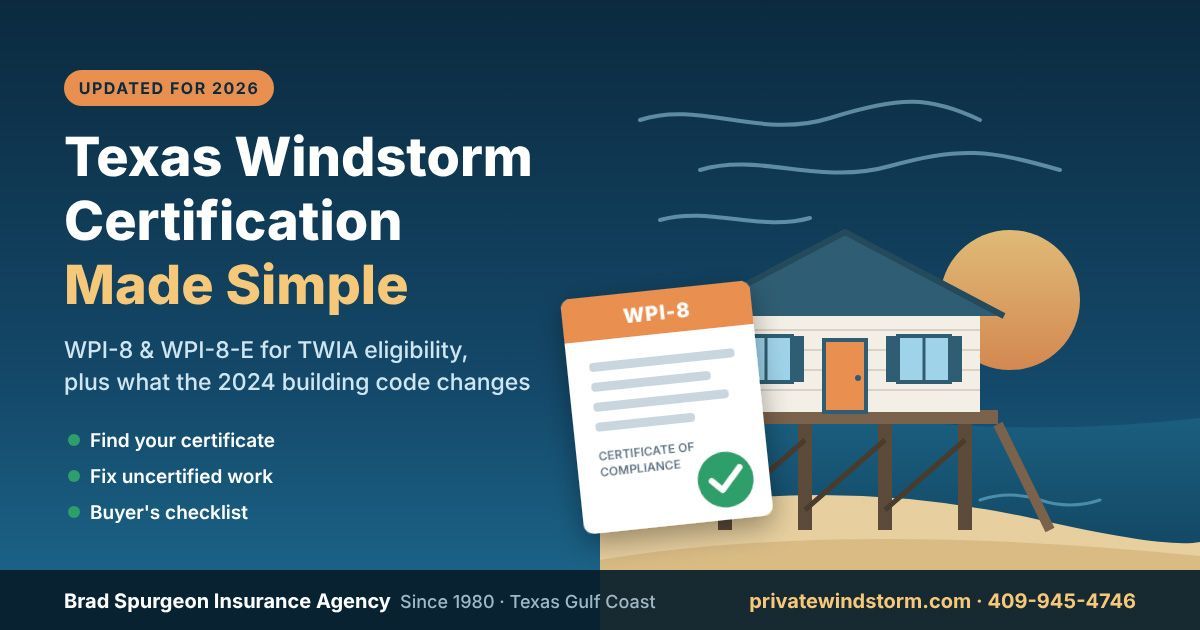
WPI-8 Windstorm Certification graphic with a house on stilts, waves, sun, and a gold checkmark badge
By Brad Spurgeon Insurance Agency July 20, 2026
Understand WPI-8 Windstorm Certification for Texas homeowners. Get insights on requirements & exemptions for windstorm insurance coverage.
July 17, 2026
A windstorm may damage only one section of a roof, siding, flooring, or exterior finish, yet repairing that section can leave a home with an obvious mismatch. For homeowners in Texas City, TX, understanding how matching coverage works can help set realistic expectations before a disagreement develops over the scope of
July 17, 2026
An insurance lapse can create serious financial exposure, especially when it happens without the policyholder realizing coverage has ended. For individuals and businesses in Texas City, TX, understanding why policies lapse and what to do next can help prevent avoidable gaps, penalties, and uninsured losses.
July 1, 2026
A 2026 property owner's guide to short-term rental insurance Texas requirements, Galveston vacation rental liability rules, and Jamaica Beach STR insurance mandates — including the new $1M liability requirement.
June 15, 2026
Dogs are part of the family, but they can also affect how an insurance company evaluates household liability risk. For homeowners in Texas City, TX, it is important to understand how dog ownership may influence home insurance options, premiums, exclusions, and coverage decisions before a claim ever happens.
June 15, 2026
Flood damage can create immediate questions about what can be repaired, what must be replaced, and which parts of the home are actually covered. For homeowners in Texas City, TX, appliances can be a major concern after rising water enters the property because coverage depends on the type of policy, the appliance, and w
June 15, 2026
Windstorm damage can leave homeowners dealing with roof problems, broken windows, fallen debris, and urgent repair decisions all at once. For homeowners in Texas City, TX, knowing what to do immediately after a storm can make the claim process clearer, better documented, and less stressful. Start With Safety First After a windstorm , the first priority is safety. Before checking damage, make sure everyone in the household is accounted for and away from immediate hazards. Strong winds can leave behind loose power lines, unstable trees, damaged roofs, broken glass, and weakened structures. Do not climb onto the roof or enter areas that appear unsafe. Even if the damage looks manageable from the ground, hidden structural problems can make inspection dangerous. If you smell gas, see sparks, notice major structural movement, or suspect electrical damage, leave the area and contact the proper emergency service provider. In our work with clients, a common issue we see is that homeowners try to inspect or fix damage too quickly. It is understandable to want answers right away, but safety should come before documentation, repairs, or cleanup. Prevent Further Damage When Possible Most insurance policies require homeowners to take reasonable steps to prevent additional damage after a covered loss. This does not mean making permanent repairs immediately. It means taking practical temporary measures when it is safe to do so. Examples may include: Placing a tarp over a damaged roof area Boarding up a broken window Moving undamaged belongings away from water intrusion Covering exposed openings Drying wet areas when safe Turning off water if plumbing was affected Securing loose items that could cause more damage Keep receipts for materials, labor, emergency services, tarps, storage, or temporary repairs. These expenses may be considered during the claim, depending on the policy. Document The Damage Thoroughly Good documentation can make a major difference in a windstorm claim. Take photos and videos before making temporary repairs, if it is safe. Capture wide shots of the property and close-up images of specific damage. Focus on areas such as: Roof shingles, tiles, flashing, gutters, and vents Siding, trim, soffits, and fascia Windows, doors, screens, and shutters Fences, sheds, detached structures, and carports Interior ceiling stains or water intrusion Damaged personal property Fallen trees, limbs, or debris Outdoor equipment and furniture When possible, include date-stamped photos and notes describing what happened. If neighbors near Galveston Bay or Moses Lake experienced similar storm impact, that can provide useful context, but your claim should still focus on your own property damage. Review Your Insurance Policy Before filing or during the early claim process, review your policy carefully. Windstorm coverage can vary by carrier, property location, deductible type, and policy form. Pay close attention to: Whether windstorm or hail damage is included Whether you have a separate windstorm policy Your windstorm deductible Roof coverage terms Exclusions or limitations Other structures coverage Personal property coverage Loss of use coverage Claim reporting deadlines For homeowners in Texas City, TX, windstorm coverage deserves special attention because coastal exposure can affect how coverage is written. Some homeowners may have wind coverage through a separate policy rather than their standard homeowners policy. Understand Your Windstorm Deductible A windstorm deductible may work differently from a standard deductible. Some policies use a flat deductible, such as a set dollar amount. Others use a percentage deductible based on the insured value of the home. For example, if your home is insured for a certain amount and your wind deductible is a percentage, your out-of-pocket responsibility could be higher than expected. This is why it is important to review the deductible before a storm, not after damage occurs. A common misunderstanding is assuming the deductible will be the same for every type of claim. Fire, theft, water damage, hurricane, hail, and windstorm claims may have different deductible rules depending on the policy. Contact Your Insurance Agent Or Carrier Promptly Once the property is safe and you have initial documentation, contact your insurance agent or insurance company to report the damage. Provide clear details about the date of the storm, the type of damage, and any temporary steps taken to prevent further loss. Be prepared to provide: Policyholder name Policy number, if available Property address Date and approximate time of damage Description of visible damage Photos or videos Receipts for temporary repairs Contractor estimates, if available Ask what the next steps are and whether an adjuster will inspect the property. Also ask whether there are specific forms, deadlines, or documentation requirements. Avoid Permanent Repairs Too Soon Temporary repairs are usually encouraged when needed to prevent further damage. Permanent repairs should generally wait until the insurance company has had an opportunity to inspect the damage or provide claim guidance.  If emergency permanent work is unavoidable, document everything carefully. Take photos before, during, and after the work. Keep detailed invoices, contractor notes, and material receipts. Do not discard damaged materials until the adjuster has reviewed them or until you are told it is acceptable. If damaged items must be removed for safety or sanitation, photograph them clearly first. Be Careful With Contractors After A Storm After major storms, contractors may go door to door offering inspections or quick repairs. Many are legitimate, but homeowners should still be cautious. Before hiring a contractor: Verify licensing and insurance Check reviews and references Avoid signing blank contracts Be cautious with high-pressure sales tactics Ask for written estimates Understand payment terms Confirm who is responsible for permits Do not assign claim benefits without understanding the document A professional contractor can be helpful during recovery, but the homeowner should remain in control of the claim process and policy communication. Track Communication And Expenses Keep a claim folder with all important information. This can be digital, physical, or both. Include: Claim number Adjuster contact information Dates and times of calls Emails and letters Photos and videos Repair estimates Temporary repair receipts Hotel or temporary housing receipts, if applicable Contractor invoices Notes from inspections This record can help if there are questions about timing, scope, costs, or claim decisions. Organized documentation also makes it easier to compare estimates and understand what is being paid. Watch For Hidden Damage Windstorm damage is not always obvious immediately. A roof may look acceptable from the ground but still have lifted shingles, damaged flashing, or compromised seals. Water intrusion may appear later as ceiling stains, bubbling paint, soft drywall, or musty odors. After a storm, monitor the home for several days or weeks. If you notice new signs of damage, document them and notify the insurance company promptly. Hidden damage may be especially important after strong gusts, flying debris, or wind-driven rain. Delayed reporting can make it harder to connect the damage to the storm event. Know What May Not Be Covered Windstorm insurance does not cover every storm-related issue. Flooding from rising water is typically handled separately through flood insurance. Damage from poor maintenance, wear and tear, old roof conditions, or pre-existing problems may be limited or excluded. For example, if wind damages the roof and rain enters through the storm-created opening, the resulting interior damage may be evaluated under windstorm coverage. But if water enters because of long-term deterioration or an unrepaired leak, coverage may be more limited. This distinction is important for homeowners in Texas City, TX because severe weather can involve multiple causes of damage. Wind, rain, flood, and maintenance-related issues may be handled differently. Conclusion A windstorm claim is easier to manage when homeowners act quickly, document thoroughly, prevent further damage, and understand their policy . The most important steps are to stay safe, take photos and videos, make reasonable temporary repairs, report the claim promptly, and keep detailed records. Windstorm coverage can be complex, especially when deductibles, roof terms, separate policies, and flood exclusions are involved. Reviewing your coverage before storm season and following a clear checklist after damage can help protect your home and reduce claim confusion. At Brad Spurgeon Insurance Agency Inc., we aim to provide comprehensive insurance policies that make your life easier. We want to help you get insurance that fits your needs. You can get more information about our products and services by calling our agency at (409) 945-4746. Get your free quote today by CLICKING HERE . Disclaimer: The information presented in this blog is intended for informational purposes only and should not be considered as professional advice. It is crucial to consult with a qualified insurance agent or professional for personalized advice tailored to your specific circumstances. They can provide expert guidance and help you make informed decisions regarding your insurance needs. Brad Spurgeon Insurance Agency Texas City, TX (409) 945-4746 https://www.privatewindstorm.com/
June 15, 2026
Mobile and modular homes can offer flexibility, affordability, and practical living space, but insuring them is not always the same as insuring a traditional site-built home. For homeowners in Texas City, TX, understanding how coverage works can help avoid gaps before a storm, fire, theft, or liability claim creates a
May 17, 2026
A property inspection can feel intimidating if you are not sure what the insurance adjuster is reviewing or how the visit may affect your claim.
Show More