TWIA · Windstorm & Hail · Texas Gulf Coast

August 25, 2026

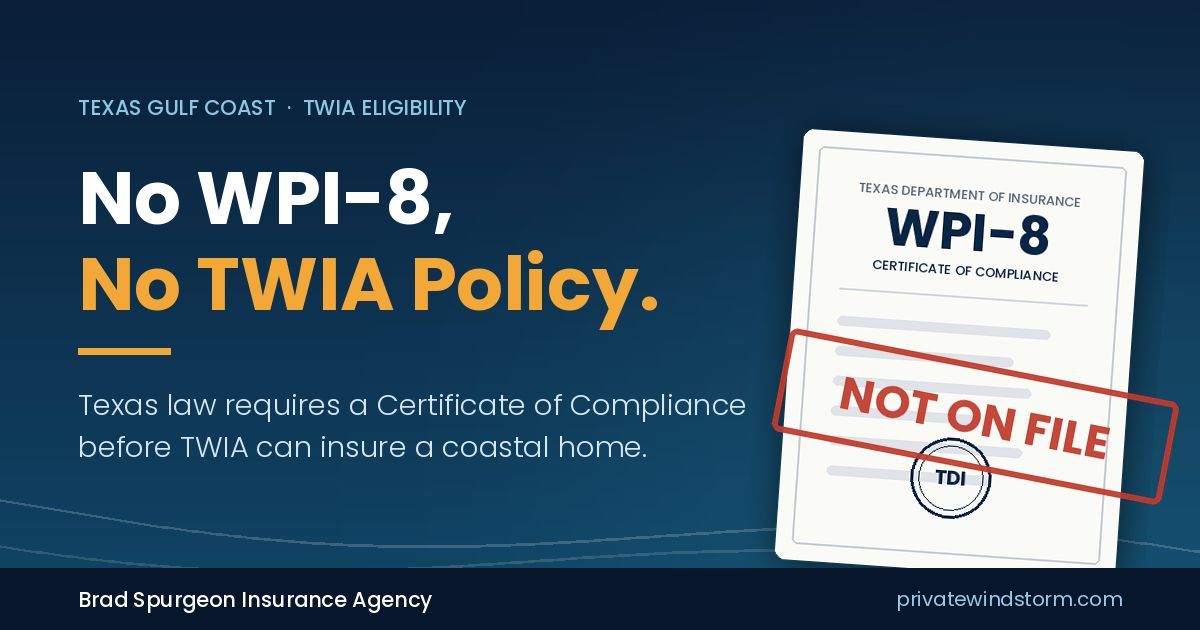
Every hurricane season we field some version of the same call. A homeowner in Texas City, Galveston, or Freeport is ready to buy a TWIA policy, the down payment is sitting in the checking account, and the closing is nine days out. Then the application comes back, and the answer is no — not because of the roof's age, not because of a claim history, but because there is no WPI-8 on file.


It is a frustrating answer, and it is worth understanding why TWIA gives it. The Association is not exercising discretion in these cases. It is following the statute that created it.

TWIA Is Not Choosing to Require It — State Law Does

The Texas Windstorm Insurance Association was created by the Legislature in 1971 as the insurer of last resort for wind and hail coverage along the coast. It is governed by Chapter 2210 of the Texas Insurance Code, and Chapter 2210 is where the certification requirement lives. Sections 2210.251 through 2210.252 and 2210.258 through 2210.259 set out the building code and inspection standards a structure has to satisfy before TWIA can insure it, along with the narrow exceptions the Legislature carved out.


A Certificate of Compliance — the WPI-8, or its siblings the WPI-8-E and WPI-8-C — is the evidence that those standards were met. TWIA's own position is direct: without a Certificate of Compliance, it has no evidence the structure conforms to the applicable building code, and the property may be considered uninsurable and ineligible for coverage.


That distinction matters when you are on the phone with an underwriter. This is not a document TWIA can waive as a courtesy, and it is not something an agent can argue around. It is a statutory eligibility condition. No certificate, no evidence. No evidence, no policy.

The January 1, 1988 Line

The requirement applies to all structures constructed, altered, remodeled, enlarged, repaired, or added to on or after January 1, 1988, within the designated catastrophe area.


Read that list again, because homeowners routinely misread it. The requirement is not limited to new construction. A house built in 1974 is not automatically exempt forever — it is exempt only for the original construction. The moment someone replaces the roof, adds a garage, swaps out the windows, or re-sides a significant portion of an exterior wall, that work falls under the requirement and needs its own certificate. This is the single most common way a long-insured coastal home quietly loses its eligibility: a roof gets replaced after a hail storm, the contractor never files a WPI-1, and nobody notices for four years.


Improvements that commonly require certification include new structures, additions and enlargements, windows, entry doors and garage doors, patio covers, decks, roof replacement or repair of a significant portion of a roof, and re-siding a significant portion of an exterior wall.


Work that does not require certification includes painting, carpeting and refinishing, plumbing and electrical repairs, fence repair, gutter repair or replacement, and temporary repairs made after a storm. TDI maintains the full list of exempt repairs on its website.

Four Places a Missing Certificate Costs You

At application. The most straightforward version. TWIA cannot issue a new policy on a structure it cannot verify. The sale stalls, or the buyer scrambles for surplus lines coverage at a materially higher premium.


At renewal. Homeowners assume that once they are in, they are in. But uncertified work performed during the policy term can render the structure ineligible going forward. The re-roof that happened in March can become a non-renewal notice in November.


At claim time. This is the expensive one. A wind or hail claim triggers scrutiny of the structure, and if an inspector documents work that was never certified, the eligibility question surfaces at the worst possible moment — when there is already a tarp on the roof and a contractor waiting on a check.


At the closing table. Coastal lenders require windstorm coverage. If TWIA is unavailable and the private market prices the risk out of reach, financing falls through. Sellers who assumed a WPI-8 was a formality find out otherwise about ten days before closing.

The Two Exceptions Written Into the Code

The Legislature did build in two limited exceptions, and it is worth knowing them precisely, because homeowners tend to hear about them secondhand and assume they are broader than they are.


The 1988 to June 18, 2009 exception. Residential properties with construction from 1988 through June 18, 2009 that were never certified may still be eligible for TWIA coverage. That eligibility comes with a 15 percent surcharge based on and in addition to the policy premium. This is a paid workaround, not a clean pass — and it does not cover work performed after June 18, 2009.


The private-market non-renewal exception. Residential properties that were insured on or after June 19, 2009 by a private-market insurer, and were then cancelled or non-renewed by that insurer while missing a required WPI-8 at the time, may be eligible for TWIA coverage.


Both exceptions are narrow and fact-specific. Whether a particular property qualifies depends on construction dates, prior coverage history, and documentation you may need to produce. That is a conversation to have with your agent before you assume the answer, not after.

How to Find Out What Your Home Already Has

Most homeowners have never looked, and a surprising number of properties already have certificates nobody knew about.

  • TDI's online database holds the majority of WPI-8s and WPI-8-Es. You can search by address and print what is on file.
  • TWIA's certificate lookup tool covers the WPI-8-Cs that TWIA itself issued for completed improvements between January 1, 2017 and May 31, 2020. Those certificates are not currently available through TDI's site, so a property can look uncertified in one system and be certified in the other.


As of June 1, 2020, all Certificates of Compliance are issued by TDI through its Windstorm Inspection Program.

If the Certificate Is Missing

The path depends entirely on whether the work has already been done.


Work not yet started. This is the good position to be in. File Form WPI-1 with TDI before construction begins, and a TDI inspector performs the required inspections at the appropriate stages at no charge. When the inspections are approved, TDI issues the WPI-8.


Work already completed. The free path is closed because TDI inspectors must inspect during construction. Instead, a TDI-appointed qualified inspector or a Texas-licensed professional engineer evaluates the finished improvement and submits the required information to TDI, which then issues a WPI-8-E for the completed work. Engineers set their own fees, and verifying concealed framing or fastening sometimes means opening up finished surfaces.


The cost difference between those two paths is the entire argument for calling your agent before the contractor starts, not after the last shingle goes on.

The Practical Takeaway

If you own property in one of the designated coastal counties, treat the WPI-8 as part of the permanent record of the house, alongside the deed and the survey. Pull your certificates before you list a home, before you close on one, and before any contractor touches the roof or the envelope. It takes a few minutes, and it prevents the version of this call that starts with "we close Friday."

Questions About Your Property's Eligibility?

We work with TWIA eligibility, WPI-8 certification, and windstorm claims across the Texas Gulf Coast every day. If you are not sure what is on file for your home, or you are planning work that might affect it, we are glad to look at it with you.


Call us at (409) 945-4746 or email brad@bradspurgeonins.com.

Related Reading


Thank you,

Brad Spurgeon

www.privatewindstorm.com

Main Phone: (409) 945-4746


This article is provided for general educational purposes and does not constitute legal, engineering, or insurance advice. Eligibility requirements, exceptions, and surcharges are established by the Texas Insurance Code and administered by TWIA and the Texas Department of Insurance, and are subject to change. Contact our office, TWIA, or TDI directly at (800) 248-6032 to confirm the requirements that apply to your specific property.

A smiling parent sits on a couch and lifts a happy young child
August 19, 2026
Kids explore everything, and that curiosity is part of what makes childhood fun — but it also means everyday spaces in your home can hide risks you might not think twice about as an adult. A few thoughtful changes around the house can prevent the kinds of accidents that send families to the emergency room every year.
A view of two suburban houses
August 17, 2026
It's a question we hear often in Texas City, especially once a tropical system starts showing up in the forecast: can I still get flood insurance now, or is it too late? The honest answer is that it depends on your policy type and timing, and understanding how flood insurance waiting periods work can save you from a co
An American Red Cross emergency kit with supplies like water, a flashlight, goggles, and a poncho for flood survival.
August 10, 2026
Living near the Texas Gulf Coast means flooding isn't a rare or distant threat — it's a real possibility every hurricane season, and sometimes even after a heavy afternoon thunderstorm. Whether you're right along the water or a few miles inland, knowing how to prepare, evacuate, and recover safely can make all the diff

Two people holding hands while walking along a paved path in a sunlit park.
By Brad Spurgeon August 4, 2026
Explore activities like dancing, gardening, & yoga to keep seniors healthy. Contact us for tailored insurance solutions today!
A suburban street with modern houses against a mountain backdrop
August 4, 2026
Learn 9 ways to protect your home from windstorms. Ensure safety & get windstorm insurance. Contact Brad Spurgeon Insurance Agency today!
A brown shingled home with a wrap-around porch, featuring text overlays about roofing maintenance and home insurance.
By Brad Spurgeon August 4, 2026
Learn 4 roofing maintenance tips to protect your home. Update your home insurance for better coverage. Contact Brad Spurgeon Insurance Agency today!
Close-up of a white car parked on gravel, with text at the bottom asking,
August 4, 2026
Understand when to inflate your tires for safety & efficiency. Contact Brad Spurgeon Insurance Agency for your insurance needs.
Flood water surrounds buildings under a bridge. Brown water, trees, and houses are visible.
August 4, 2026
Learn essential tips for flash flood safety, including preparation & recovery. Contact Brad Spurgeon Insurance Agency for flood insurance solutions.
Debris from a windstorm scatters across a neighborhood with damaged houses and broken trees.
August 3, 2026
If you've lived on the Gulf Coast for any length of time, you already know that windstorms aren't a matter of if but when. Between tropical systems rolling in off the water and the strong seasonal gusts that sweep through Galveston County, Texas City homeowners face wind exposure most of the year. The good news is that
Show More