
Texas Hurricane & Windstorm Insurance (2026) TWIA, Ex-Wind, Flood — How the Three Policies Fit Together

September 7, 2026
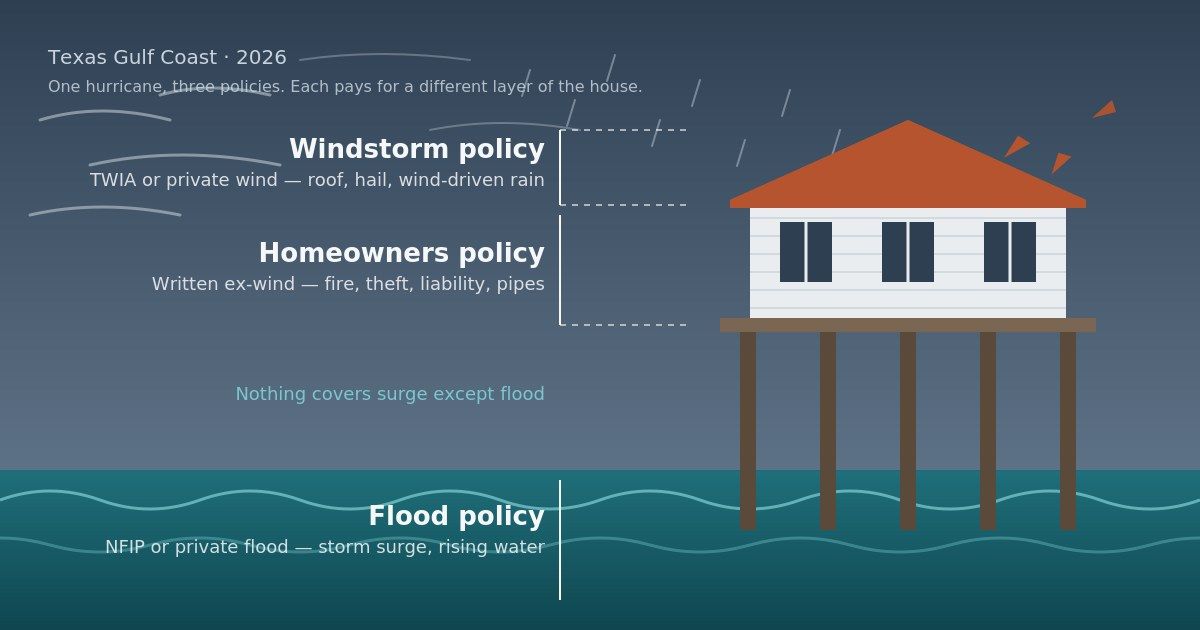
House on stilts in floodwaters with labels for homeowners and flood insurance policies

Written by Brad Spurgeon, Licensed Texas Property & Casualty Agent — Brad Spurgeon Insurance Agency Inc., Texas City, TX.  Last updated September 4, 2026

Quick answer: There is no single "hurricane insurance" policy in Texas. On the Gulf Coast, a hurricane's damage is split across three separate policies: a homeowners policy written ex-wind (everything except wind and hail), a windstorm policy from TWIA or a private carrier (wind and hail only), and a flood policy from the NFIP or a private flood insurer (storm surge and rising water). If any one of the three is missing, part of a hurricane loss is uninsured — and after every major Gulf storm, the gap that hurts the most is almost always flood.


Updated September 4, 2026 — reflects TWIA's 2026 policy limits, the 2025 Texas legislative changes to TWIA funding, the September 1, 2026 TWIA coverage adjustment, and the NFIP's September 30, 2026 authorization deadline.

Contents

Why Texas splits hurricane coverage into three policies

Texas homeowners on the coast carry three policies because three different markets decided, at three different times, that they would not carry a specific peril.


In most of Texas, a standard HO-3 or HO-5 homeowners policy covers wind and hail automatically. A tornado in Denton or a hailstorm in Lubbock is paid by the home policy, period. On the coast, the concentration of hurricane exposure is so high that most admitted carriers either refuse to write wind in the coastal counties or write the home policy with a **windstorm exclusion** — an "ex-wind" policy. The Texas Legislature created the Texas Windstorm Insurance Association (TWIA) in 1971 to fill that hole. TWIA sells wind and hail coverage and nothing else.


Flood was carved out much earlier, nationally. No homeowners policy in the United States covers rising water, so Congress created the National Flood Insurance Program (NFIP) in 1968. Hurricane storm surge is rising water, which means the single most destructive thing a Gulf hurricane does to a coastal home is never covered by the home policy or the wind policy.


That leaves the coastal homeowner assembling the coverage a homeowner in Austin gets in one contract:

Policy What it covers in a hurricane Who sells it
Homeowners (ex-wind HO-3/HO-5) Fire, theft, liability, non-storm water (burst pipes), and everything the wind and flood policies don't Admitted carriers
Windstorm & hail Wind damage, hail damage, and rain that enters through a wind-created opening TWIA or a private windstorm carrier
Flood Storm surge, rising water, and mud or debris carried by flood water NFIP (through an agent) or a private flood insurer

Some coastal homes have a fourth layer — an excess windstorm policy from the surplus lines market — when the dwelling is worth more than TWIA's cap. We'll cover that below.

Where you need a separate windstorm policy: the TWIA catastrophe area

You are inside TWIA's designated catastrophe area if your property is in one of the 14 first-tier coastal counties or in the portion of Harris County east of State Highway 146. Inside that area, assume your homeowners policy excludes wind until your declarations page proves otherwise.


The 14 first-tier counties, north to south along the coast:

  • Jefferson: Beaumont, Port Arthur, Sabine Pass
  • Chambers: Anahuac, Winnie
  • Galveston: Galveston Island, Bolivar Peninsula, League City, Texas City
  • Brazoria: Pearland, Lake Jackson, Freeport, Surfside
  • Matagorda: Bay City, Matagorda, Sargent
  • Calhoun: Port Lavaca, Port O'Connor, Seadrift
  • Refugio
  • Aransas: Rockport, Fulton
  • San Patricio: Portland, Aransas Pass, Ingleside
  • Nueces: Corpus Christi, Port Aransas, Padre Island
  • Kleberg: Kingsville
  • Kenedy
  • Willacy: Port Mansfield, Raymondville
  • Cameron: Brownsville, South Padre Island, Port Isabel
  • Plus Harris County east of Highway 146: Seabrook, parts of La Porte, Shoreacres, and the bayside communities along Galveston Bay.


Two things trip people up here:


  • The county line is not the risk line. A home in Pearland (Brazoria County, inland, 30+ miles from open water) is in the catastrophe area. A home in Baytown (Harris County, west of 146) is not, even though it sits on Galveston Bay. The map follows statute, not storm surge.
  • Being inside the area does not force you into TWIA. It means you may need a separate wind policy and may be eligible for TWIA. Whether you land with TWIA or a private windstorm carrier depends on your home, not your ZIP code — see the declination rule below.


If you live in a second-tier county (Harris west of 146, Fort Bend, Liberty, Victoria, Jim Wells, Hidalgo, and others), your homeowners policy usually still includes wind, but often with a
separate, higher wind/hail or named-storm deductible. Read your declarations page.

Which policy pays for what after a hurricane

After a hurricane, adjusters from up to three different companies will walk the same house and each will only pay for the damage their contract covers. Knowing the split in advance is how you avoid a six-month fight about causation.

Damage Policy that responds
Shingles torn off, roof decking exposed Windstorm
Rain that came through the roof after wind opened it Windstorm
Windows broken by wind-borne debris Windstorm
Fence blown down Windstorm (subject to policy's other-structures limit)
Storm surge in the living room Flood
Bay water backing up through the slab or into the garage Flood
Tree that fell on the roof (wind knocked it down) Windstorm
Tree that fell on the roof (rotten, no wind) Homeowners
Spoiled food after a week without power Homeowners, if you carry the endorsement
Hotel bills while the house is uninhabitable Whichever policy covers the damage that made it uninhabitable — wind or flood; ALE limits and rules differ sharply between the two
Looting of the damaged home Homeowners
Mold that developed after flood water Flood (very limited) — mold that developed after wind-driven rain is a windstorm question
Cars in the garage Auto policy (comprehensive), regardless of cause

The line that gets litigated most: wind-driven rain versus rising water. If your ground floor is wet and there's a water line at 30 inches, that's flood. If your ceiling is wet under a section of missing roof, that's wind. If both happened — and in a landfalling hurricane they usually do — you need both policies, and you need photos taken before anyone starts ripping out drywall.


Texas Insurance Code Chapter 542 (the Prompt Payment of Claims Act) sets deadlines for carriers to acknowledge, investigate, and pay claims, with interest penalties for delay. It applies to your homeowners and private windstorm carriers. TWIA claims are governed by a separate process under Chapter 2210 with its own appraisal and dispute rules and shorter deadlines for you to act — know which process applies before you file.

TWIA in 2026: limits, eligibility, rates, and what changed

TWIA is the state-created windstorm and hail insurer for the catastrophe area. As of Q1 2026, TWIA's exposure is heaviest in Galveston County, followed by Brazoria and Nueces. It is a residual market, not a state agency, and it is funded by premiums, a catastrophe reserve, member-company assessments, state financing arrangements, and reinsurance — not by general tax revenue.

2026 maximum limits

For policies issued or renewed on or after January 1, 2026, TWIA's maximum liability limits are:

Property type 2026 maximum
Residential dwelling and its contents (single family, individually owned townhouse) $1,773,000
Contents of an apartment, condo, or townhouse unit $374,000
Manufactured home $119,000
Commercial or governmental structure and contents $4,424,000

TWIA proposed inflation increases of roughly 2–2.8% across the board for 2026. The Commissioner of Insurance approved only the manufactured-home increase and disapproved the rest, so the residential dwelling cap stayed at $1,773,000 for another year. Note that the cap is a combined dwelling-and-contents number on a single-family policy — a $1.5 million home with $400,000 of contents is already over it.


If your replacement cost exceeds the cap, you need TWIA (or a private wind policy)
plus an excess windstorm policy from the surplus lines market. This is common on the west end of Galveston Island, in Port Aransas, and on South Padre. Ask your agent to quote the excess layer at the same time as the primary layer so the attachment point matches.

Coverage A grows automatically at renewal

TWIA's Automatic Adjusted Building Cost endorsement (TWIA-220) raises your Coverage A dwelling limit at each renewal based on construction cost indexes. Residential renewals on or after September 1, 2026 will see an increase of about 3%. That's a good thing — it keeps you from quietly falling behind replacement cost — but it also raises your premium and, because named-storm deductibles are a percentage of Coverage A, raises your deductible in dollars. Check both numbers on your renewal.

Rates: no increase for 2026

TWIA's Board filed for no rate change for 2026 after its actuarial analysis found rates only about 3% inadequate for residential and 5% for commercial — a dramatic improvement from prior years, attributed to the 2025 legislative session. The average TWIA residential premium was roughly $2,877 as of March 31, 2026. Your premium will differ based on county, distance to the coast, construction, roof, deductible, and Coverage A.

What the 2025 Legislature changed

Three bills from the 89th Legislature matter to policyholders:


  • HB 3689 restructured TWIA's catastrophe funding. TWIA may now borrow up to $1 billion from the state's Economic Stabilization ("Rainy Day") Fund when storm losses exceed premiums and the Catastrophe Reserve Trust Fund. The loan must be repaid within three years through a statewide surcharge on property insurance policies — meaning a Houston or Dallas homeowner helps repay a Galveston storm. The law also lowered TWIA's minimum required funding to a 1-in-50-year probable maximum loss, which cut reinsurance costs.
  • HB 2517 exempted TWIA and the Texas FAIR Plan from state premium and maintenance taxes, freeing money for claims and reducing rate pressure.
  • HB 2518 tightened rules on premium-financing arrangements for TWIA policies.


For the 2026 storm season, TWIA's Board set the 1-in-50 PML at $4.3 billion and is carrying roughly $2 billion in statutory funding plus about $2.28 billion in reinsurance and catastrophe bonds. TWIA has never been unable to pay a claim since 1971. Hurricane Beryl (2024) exhausted the catastrophe reserve, which is why the funding reform mattered.

Second homes and beach cabins: coverage stays

In late August 2026, TWIA's legislative committee considered — and then removed from consideration — a proposal to limit residential TWIA coverage to owner-occupied homesteads, which would have affected roughly 53,620 second homes and beach cabins. That proposal is off the table for the 2026 Biennial Report to the Legislature. Topics that did move forward for the report include FORTIFIED construction incentives, depopulation program changes, funding-structure refinements, and litigation reform. If you own a weekend place in Crystal Beach or Port O'Connor, your TWIA eligibility is unchanged heading into 2027.

The windstorm building code moved to the 2024 IRC/IBC

Effective April 1, 2026, the Texas windstorm building code adopted the 2024 International Residential Code and International Building Code. New construction, additions, and re-roofs permitted after that date must meet the new standard to earn a WPI-8. If you are mid-project, confirm which code edition your inspector is certifying to.

The declination rule: why TWIA is not your first stop

To buy a TWIA policy, your agent must be able to document that at least one authorized insurer actively writing windstorm coverage in the catastrophe area declined to write your home. TWIA is the market of last resort by statute, and it enforces that.


In practice, this is why a good coastal agent quotes the private market first — not because private wind is always better, but because you are required to try. The declination requirement is also why two neighbors in identical-looking houses can end up with different carriers: the one with a 2019 roof, a WPI-8 on every improvement, and impact-rated garage doors gets a private wind quote; the one with a 2008 roof and an uncertified sunroom addition gets declined and goes to TWIA.


Full TWIA eligibility, per TWIA's plan of operation:


  1. Property is in the designated catastrophe area.
  2. At least one authorized private insurer has declined to write wind and hail.
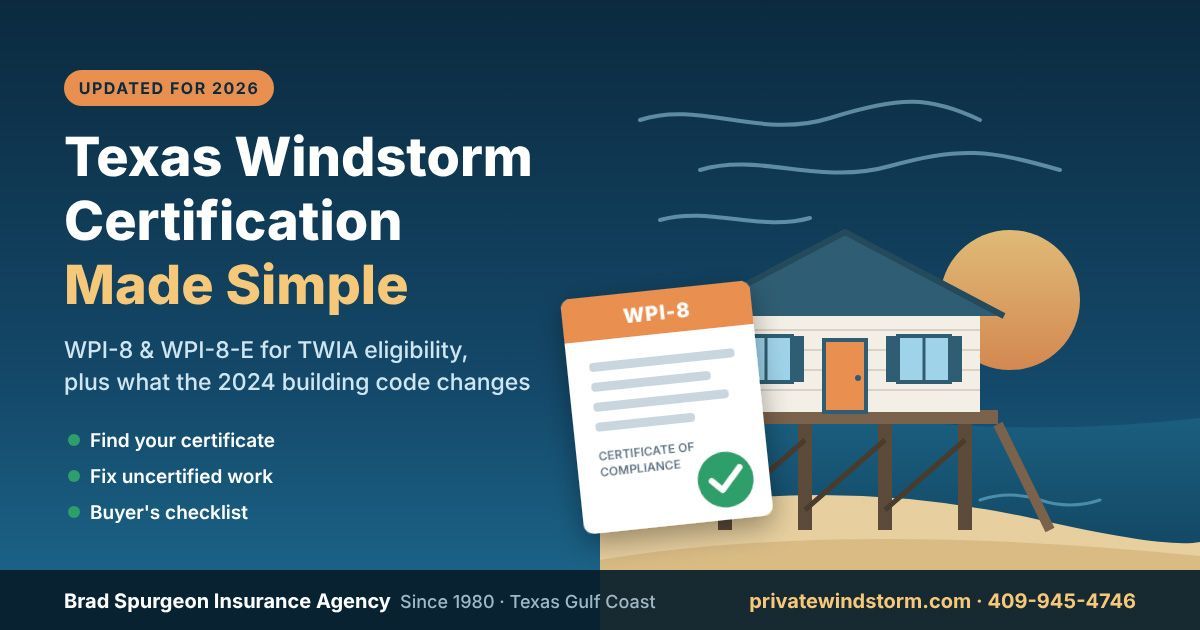
  3. The structure — and every addition, alteration, remodel, enlargement, or repair since January 1, 1988 — carries a windstorm Certificate of Compliance (WPI-8, WPI-8-E, or WPI-8-C), with limited exceptions.
  4. If the property is in flood zone V, VE, or V1–V30 and was constructed, altered, remodeled, or enlarged on or after September 1, 2009, and NFIP coverage is available, you must show proof of a flood policy.
  5. The property is in insurable condition — no unrepaired damage, deteriorated roof, or hazardous conditions.


Item 4 is the one most people have never heard of: for high-velocity coastal V zones,
TWIA will not write wind unless you already have flood. The flood policy must equal at least the smallest of 90% of the TWIA dwelling amount, 90% of actual cash value, or the NFIP maximum ($250,000 on a residential building). TWIA regularly inspects properties — physically and by aerial imagery — and will re-check eligibility at any time.

WPI-8 certificates: the paperwork that decides insurability

A WPI-8 is a windstorm Certificate of Compliance issued by the Texas Department of Insurance confirming that a structure — or a specific improvement to it — was built to the windstorm building code in effect at the time. TWIA requires one on every structure and every improvement made since 1988. Most private windstorm carriers require one too, and lenders on coastal purchases increasingly ask for it at closing.


There are three flavors you'll see in a title file:

Certificate Issued by For
WPI-8 TDI Ongoing construction inspected during the build (new homes, re-roofs, additions)
WPI-8-E TDI Completed improvements certified by a Texas-licensed engineer after the fact
WPI-8-C TWIA Completed improvements certified between January 1, 2017 and May 31, 2020 (TWIA no longer issues these; TDI issues everything now)

What homeowners get wrong:

  • A WPI-8 is per improvement, not per house. A home built in 2005 with a certificate for the original construction still needs a separate certificate for the 2015 re-roof, the 2019 window replacement, and the 2022 covered porch. An uncertified addition can leave that portion of the house without wind coverage even when the rest is insured.
  • Repairs count. The 1988 rule covers structures "constructed, altered, remodeled, enlarged, repaired, or to which additions have been made." A post-Beryl roof repair that wasn't inspected is a problem at your next TWIA renewal.
  • Non-compliant structures can sometimes still get TWIA — with a 15% surcharge. Certain older structures qualify under limited exceptions with a premium surcharge instead of a certificate. Ask before assuming you're locked out.
  • You can look them up. TDI maintains a searchable database of issued certificates by address. Pull it before you list, before you make an offer, and before you hire a roofer.
    If you don't have one: a TDI-appointed qualified inspector or a Texas-licensed engineer can evaluate the structure. If it meets the applicable code, they certify it. If not, they'll document what has to change — commonly roof-deck fastening, roof-to-wall connections, window and door pressure ratings, or garage door bracing. Budget for the inspection and the fixes when pricing an older coastal home.

Named-storm deductibles: do the math before you bind

Coastal wind policies — TWIA and private — carry a percentage deductible, and it is calculated on your Coverage A dwelling limit, not on the size of the claim. Most coastal policies have at least two: a wind/hail deductible for ordinary storms and a higher named-storm or hurricane deductible that applies only when the National Hurricane Center has named the system.


Here is what those percentages cost on a $450,000 Coverage A limit — roughly the median replacement cost for a three-bedroom in Galveston County in 2026:

Deductible Out of pocket per claim
1% $4,500
2% $9,000
3% $13,500
5% $22,500
10% $45,000

Three details buried in the fine print:


  1. The trigger. A named-storm deductible applies when damage is caused by a system that has been named — or, in many policy forms, during a window that begins when the NHC issues a watch or warning for your area and ends 24 to 72 hours after it is lifted. Exact language varies by carrier. A storm that makes landfall as an unnamed tropical depression may fall under the lower wind/hail deductible.
  2. It resets per occurrence. Two named storms in one season are two deductibles. Some private forms offer a calendar-year aggregate hurricane deductible; TWIA does not.
  3. It scales with your ABC increase. As your Coverage A rises 3% at your September 2026 TWIA renewal, so does your deductible in dollars.


How to choose: take the dollar amount of the deductible you're considering and ask whether you could write that check the week after a storm, when contractors want deposits and your flood claim hasn't paid yet. If the answer is no, the premium savings from a 5% versus a 2% deductible are not savings. On most Galveston County homes the difference between 2% and 5% runs a few hundred dollars a year; the difference in a Beryl-sized claim was more than $13,000 on the example above.

Private windstorm vs. TWIA: a side-by-side

The private windstorm market on the Texas coast has grown substantially since Hurricane Ike (2008), with admitted carriers, surplus lines companies, and Lloyd's syndicates now writing wind in first-tier counties on newer, better-built homes. The right choice depends on your house, not your loyalty.

Why "I'm not in a flood zone" is not a reason to skip it

Over the ten years from 2014 to 2024, about 29% of NFIP flood claims came from properties outside FEMA's high-risk Special Flood Hazard Areas. FEMA's maps are regulatory tools for lending and building, not predictions of where water will go in a specific storm. Harvey flooded tens of thousands of Houston-area homes in X zones. Beryl flooded homes in Brazoria and Matagorda counties that had never seen water.


If you're in an X zone (moderate to low risk), NFIP premiums are typically among the least expensive coverage you can buy on a coastal home. There's no lender mandate, so it's a decision you have to make on purpose.

Factor TWIA Private windstorm
Eligibility Requires a private-market declination, WPI-8s, insurable condition Carrier-specific underwriting; favors newer roofs, full certificate history, FORTIFIED features
Dwelling limit $1,773,000 including contents (2026) Can exceed TWIA's cap; may eliminate the need for excess wind
Policy form Standardized; roof settled on replacement cost Varies — read the roof clause; some forms pay actual cash value on roofs over a certain age
Deductible options 1%–5% named storm and wind/hail, with limited flexibility Wider range; some offer flat-dollar or aggregate options
Rate setting Filed with TDI; no increase for 2026 Market-driven; can move sharply after a bad reinsurance year
Claims TWIA adjusters; Chapter 2210 dispute process with strict policyholder deadlines Carrier adjusters; Chapter 542 prompt-payment rules apply
Backstop State financing arrangements, member assessments, reinsurance Carrier's own capital plus the Texas Property & Casualty Insurance Guaranty Association if the carrier fails (surplus lines carriers are not covered by the Guaranty Association)
Bundling Wind only; homeowners and flood are separate Some carriers write wind-included homeowners in the coastal area, collapsing two policies into one

The most important line is the last one. A wind-included homeowners policy from a private carrier — where they've agreed to keep wind inside the HO-3 — is the closest thing to "normal" insurance a coastal Texan can get. It is available on a minority of coastal homes, generally newer construction with a clean WPI-8 file, and it's worth asking about at every renewal, because the answer changes as your roof ages and as carriers' appetites shift.

The flood policy: storm surge, the NFIP, and the September 30 deadline

Flood insurance is the policy that pays for what a hurricane does at ground level. No homeowners policy covers it, no windstorm policy covers it, and TWIA does not cover it. On the Texas coast, storm surge — the wall of Gulf water a hurricane pushes ashore — is the deadliest and most destructive element of the storm. A Category 2 hurricane can produce a surge of 6 to 8 feet in Galveston Bay; Ike's surge in 2008 exceeded 15 feet on Bolivar Peninsula.

What an NFIP policy actually covers

Building Contents
NFIP residential maximum $250,000 $100,000
Valuation Replacement cost for a primary residence insured to at least 80% of value or the NFIP max; otherwise actual cash value Actual cash value (always)
Basement and below-grade areas Limited — structural elements and mechanicals only Generally not covered
Additional living expense Not covered
Detached structures Not covered unless separately insured (except a detached garage, limited)

Two takeaways for coastal Texans: NFIP does not pay for a hotel while your house dries out, and $250,000 is not enough to rebuild most Galveston, Kemah, or Corpus Christi homes. Excess flood and private flood policies fill both gaps — higher limits, replacement-cost contents, ALE — and are increasingly competitive on elevated or newer homes. Since 2021, NFIP has priced every policy under Risk Rating 2.0, which uses the specific property's distance to water, elevation, and rebuild cost rather than the flood-zone letter alone; if your NFIP quote surprises you, get a private flood quote before you bind.

The 30-day waiting period

A new NFIP policy takes effect 30 days after purchase. The exceptions are narrow: a policy required by a lender in connection with a loan closing takes effect immediately, and a policy bought within 13 months of a map revision that newly placed the property in a high-risk zone takes effect the next day. You cannot buy flood insurance the week a storm is in the Gulf. Private flood waiting periods are usually shorter — often 10 to 15 days — but no carrier binds new flood coverage once a named storm is in the basin.

NFIP authorization expires September 30, 2026

The NFIP has operated on short-term Congressional extensions since its last long-term reauthorization ended in September 2017 — 35 of them so far. The current extension runs through September 30, 2026. During the 43-day lapse in October–November 2025, the NFIP could not issue new policies or renew existing ones, and roughly 1,300 home sales a day nationwide stalled because federally backed mortgages in flood zones require coverage.


What a lapse means for you:


  • Existing policies stay in force through their expiration date, plus a 30-day grace period. Claims continue to be paid.
  • New policies and renewals stop until Congress acts. Past lapses have been reauthorized retroactively, but that's a bet, not a plan.
  • Closings in flood zones can stall. An NFIP policy can be *assigned* from seller to buyer at closing, which keeps the coverage in place without a new issuance — ask your agent and title company about it if you're closing in October.
  • Private flood is unaffected. It's a federal program that lapses, not the peril.


If your NFIP policy renews in the fourth quarter, pay the renewal early. If you've been meaning to add flood coverage, the 30-day clock and the September 30 deadline are both arguments for doing it this month.

Buying or selling a coastal home: the insurance checklist

Insurance is the third-largest recurring cost of owning a coastal Texas home after the mortgage and property taxes, and it can make or break a deal. Work through this before the option period ends.


Pull the WPI-8 history from TDI's database. Every improvement since 1988 should have a certificate. Missing certificates on a re-roof or addition are a negotiating item — the cost of an engineer's WPI-8-E inspection and any required fixes comes off the price or gets done before closing.


Get an elevation certificate. For any home in an A or V zone, an elevation certificate tells you how the lowest floor compares to base flood elevation and drives both the NFIP quote and the private flood quote. Sellers often have one; if not, a surveyor can produce one in a week or two.


Ask for the seller's declarations pages — all three. The seller's TWIA or private wind premium, flood premium, and homeowners premium are the best predictor of yours. If the seller has no flood policy, find out why before you assume it's cheap.


Check the flood zone against the TWIA flood requirement. V-zone homes built or altered after September 2009 must show flood coverage before TWIA will bind. Sequence the flood policy first.


Quote wind before you waive the option. A home that no private carrier will write and that has an uncertified addition may not be insurable for wind at any price until the addition is brought to code. That's a walk-away fact, not a closing-day surprise.


Confirm lender requirements. Most lenders require wind coverage in the catastrophe area and flood coverage in an SFHA, and many now require the wind deductible to be at or below a stated percentage. A 5% named-storm deductible can fail a lender that caps it at 2%.


Sellers: assemble all of the above into a single folder for the listing. A coastal home with a complete certificate history, a current elevation certificate, and three years of clean declarations pages closes faster and closer to list.

A 30-day pre-storm checklist for coastal homeowners

Hurricane season runs June 1 through November 30, and the Texas coast's peak is mid-August through mid-October. Once a named storm is in the Gulf, carriers issue binding restrictions — no new policies, no coverage increases, no deductible reductions — usually for a defined radius around the forecast cone. Everything on this list has to happen before that.

  1. Verify all three policies are in force with matching insured names, matching mailing addresses, and matching mortgagee clauses. A lapsed ex-wind HO-3 because a payment bounced is a common and entirely avoidable disaster.
  2. Confirm your Coverage A matches replacement cost. Construction costs on the coast have risen faster than most ABC endorsements. If your dwelling limit hasn't been reviewed since before 2022, have your agent run a current replacement cost estimate.
  3. Know your named-storm deductible in dollars, not percent, and know whether that money is liquid.
  4. Locate your flood declarations page and confirm the contents limit. NFIP contents is optional and separately purchased — many homeowners discover after a storm that they insured the building and not the furniture.
  5. Photograph and video every room, the roof, the exterior, and the contents of the garage. Time-stamp them. Store them off-site or in the cloud. This is the single highest-value thing you can do for a future claim.
  6. Save your carriers' claim numbers — TWIA, homeowners, flood, and auto — in your phone. After a landfall, agency phones are overwhelmed for days; you'll file faster directly.
  7. Keep receipts for mitigation — tarps, plywood, generator fuel, tree removal. Every policy requires you to prevent further damage, and every policy reimburses reasonable costs of doing so if you can prove them.
  8. Review your ALE. Windstorm and homeowners policies pay for a hotel; NFIP does not. If your plan depends on flood ALE, you don't have one.

Frequently asked questions

  • Is hurricane insurance required in Texas?

    No Texas law requires it. Mortgage lenders, however, almost universally require windstorm coverage inside the TWIA catastrophe area and flood coverage in a FEMA Special Flood Hazard Area, and most will not fund a loan without both.

  • Does homeowners insurance cover hurricanes in Texas?

    Away from the coast, yes — a standard HO-3 covers wind and wind-driven rain, though often with a separate percentage wind/hail deductible. In the 14 first-tier counties and Harris County east of Highway 146, homeowners policies are usually written ex-wind and do not cover hurricane wind. No homeowners policy anywhere covers storm surge or flooding.

  • What does TWIA cover?

    Wind and hail damage to the dwelling, other structures, and contents, plus rain that enters through a wind-created opening. TWIA does not cover flood, storm surge, fire, theft, liability, or plumbing leaks.

  • How much does TWIA cost in 2026?

    The average TWIA residential premium was about $2,877 as of March 31, 2026, with no rate increase filed for 2026. Homes on Galveston Island, Bolivar Peninsula, Mustang Island, and South Padre pay substantially more; homes in inland Brazoria or Jefferson County pay less. Your homeowners and flood premiums are additional.

  • Can I get TWIA without a WPI-8?

    Generally not. Every structure and improvement since January 1, 1988 must carry a Certificate of Compliance, with limited exceptions for certain older structures that may be insured with a 15% surcharge. An engineer can issue a WPI-8-E on completed work that meets the applicable code.

  • Does TWIA require flood insurance?

    Only for properties in flood zones V, VE, or V1–V30 that were constructed, altered, remodeled, or enlarged on or after September 1, 2009, where NFIP coverage is available. For those properties, proof of flood coverage is a condition of the TWIA policy.

  • What is the difference between a named-storm deductible and a hurricane deductible?

    They're usually the same thing described two ways. Both are percentage deductibles that apply only to damage from a tropical system named by the National Hurricane Center. Read your policy's definition for the exact trigger and time window — some begin at the watch or warning, some at landfall, and they end 24 to 72 hours after the watch or warning is lifted.


  • What if my home is worth more than $1,773,000?

    TWIA's 2026 residential cap includes contents. Above it, you need an excess windstorm policy from the surplus lines market layered on top of TWIA, or a private windstorm carrier with higher limits. The excess layer should attach exactly where the primary layer ends.

  • Can I buy flood insurance right before a hurricane?

    No. NFIP policies take effect 30 days after purchase, and private flood carriers stop binding once a named storm is in the Gulf. Coverage bought in September is in place for October; coverage bought when a storm is named is not.

  • What happens to my flood insurance if the NFIP lapses on September 30, 2026?

    Existing policies remain in force through their term plus a 30-day grace period, and claims continue to be paid. New policies and renewals cannot be issued until Congress reauthorizes the program. Private flood insurance is not affected.

  • Wind or flood — how do adjusters decide?

    By evidence of causation. Water lines, debris lines, and the direction of damage are documented by each adjuster. Where both perils clearly contributed, each policy pays for its portion. Where causation is disputed, Texas courts have generally placed the burden on the policyholder to segregate covered from excluded damage — which is why pre-storm photos and post-storm photos taken before cleanup are decisive.

  • I own a beach cabin I rent out. Can I still get TWIA in 2027?

    Yes. A 2026 proposal to restrict TWIA residential coverage to owner-occupied homesteads was removed from consideration for TWIA's Biennial Report to the Legislature. Non-owner-occupied and seasonal residences remain eligible under current law.

Talk to an agent who writes all three

Coastal insurance is not a product you can buy off a website because the three policies have to be sequenced and matched: flood before TWIA in a V zone, the private wind declination before the TWIA application, the excess layer attached to the primary limit, the deductibles inside your lender's cap. Brad Spurgeon Insurance Agency Inc. writes homeowners, TWIA, and private windstorm, and NFIP and private flood for homeowners from Sabine Pass to South Padre. Send us your address, and we'll pull the WPI-8 history and flood zone before we quote.


Phone: (409) 945-4746 · Email: brad@bradspurgeonins.com · Get a Quote


This article was written and reviewed by John Bradley Spurgeon, a licensed Texas insurance agent based on the Gulf Coast, specializing in homeowners, TWIA windstorm and hail, and FEMA flood insurance for coastal properties from Bolivar to South Padre. It reflects TWIA and NFIP program rules as of September 4, 2026. Policy forms, limits, deductibles, and availability vary by property and carrier. This is educational content, not a coverage determination; confirm the terms of any policy with your agent before binding.


Sources: Texas Windstorm Insurance Association — 2026 maximum liability limits, Q1 2026 Fact Book, Funding 101, Coverage & Eligibility, Flood Insurance Requirements, Automatic Adjusted Building Cost endorsement notice (July 2026), Board and Legislative Committee announcements (2025–2026); Texas Department of Insurance — Docket 2856, TWIA Overview (June 2026), Windstorm Inspections Program; Texas Insurance Code Chapters 542 and 2210; FEMA — NFIP Congressional Reauthorization; Congressional Research Service IN10835; FloodSmart.gov.

Flooded beach house on stilts with roof damage and insurance claim callouts about a Gulf Coast short-term rental
September 7, 2026
How to insure a Galveston, Crystal Beach, Surfside, or Port Aransas short-term rental: TWIA wind, NFIP flood, Fire & Liability policy, from an experienced local Gulf Coast Insurance agent.
August 25, 2026
Learn why TWIA requires WPI-8 certification, which Texas coastal homes need it, key exceptions, and what to do if your certificate is missing.
A smiling parent sits on a couch and lifts a happy young child
August 19, 2026
Kids explore everything, and that curiosity is part of what makes childhood fun — but it also means everyday spaces in your home can hide risks you might not think twice about as an adult. A few thoughtful changes around the house can prevent the kinds of accidents that send families to the emergency room every year.
A view of two suburban houses
August 17, 2026
It's a question we hear often in Texas City, especially once a tropical system starts showing up in the forecast: can I still get flood insurance now, or is it too late? The honest answer is that it depends on your policy type and timing, and understanding how flood insurance waiting periods work can save you from a co
An American Red Cross emergency kit with supplies like water, a flashlight, goggles, and a poncho for flood survival.
August 10, 2026
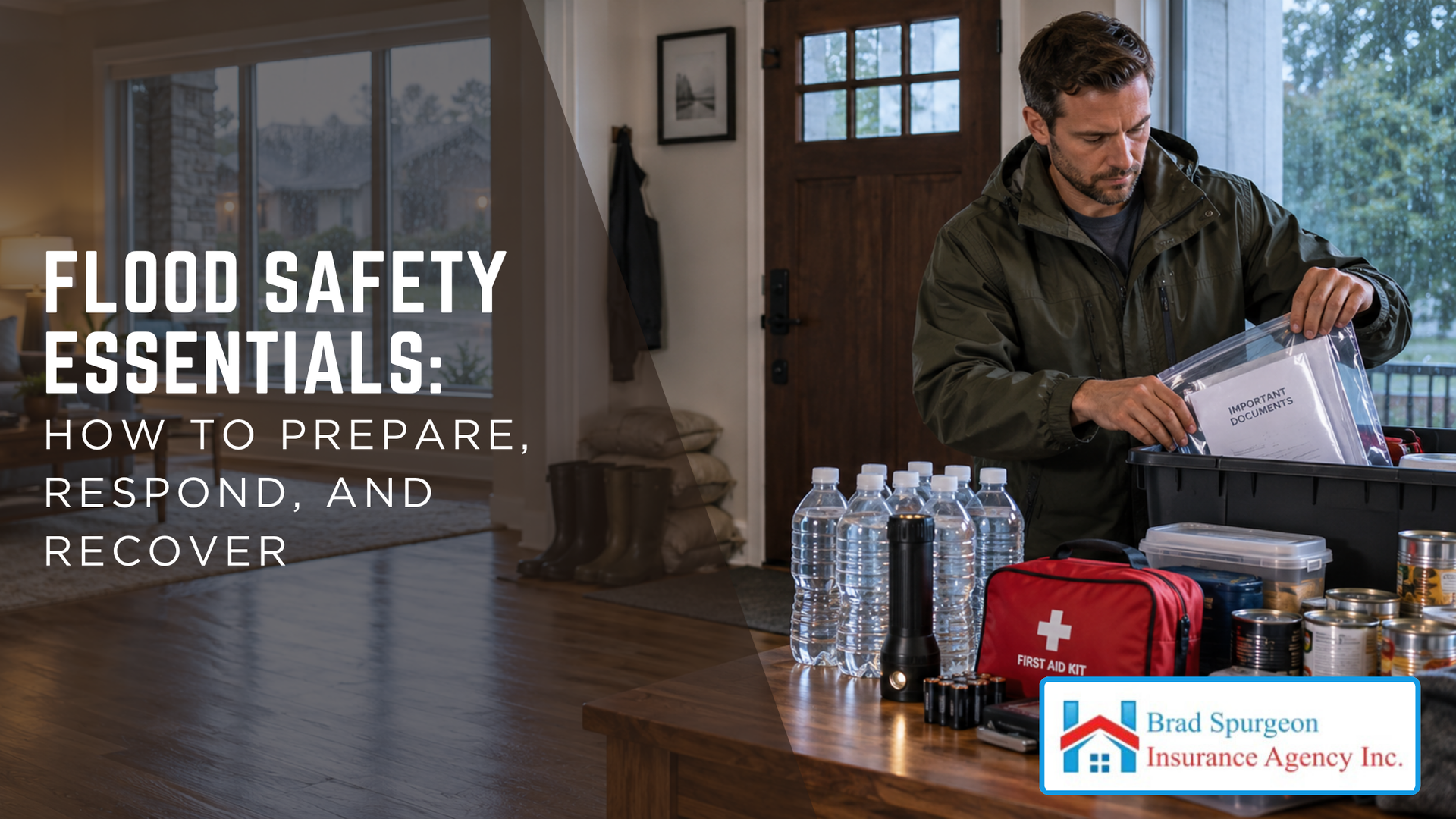
Living near the Texas Gulf Coast means flooding isn't a rare or distant threat — it's a real possibility every hurricane season, and sometimes even after a heavy afternoon thunderstorm. Whether you're right along the water or a few miles inland, knowing how to prepare, evacuate, and recover safely can make all the diff
Two people holding hands while walking along a paved path in a sunlit park.
By Brad Spurgeon August 4, 2026
Explore activities like dancing, gardening, & yoga to keep seniors healthy. Contact us for tailored insurance solutions today!
A suburban street with modern houses against a mountain backdrop
August 4, 2026
Learn 9 ways to protect your home from windstorms. Ensure safety & get windstorm insurance. Contact Brad Spurgeon Insurance Agency today!
A brown shingled home with a wrap-around porch, featuring text overlays about roofing maintenance and home insurance.
By Brad Spurgeon August 4, 2026
Learn 4 roofing maintenance tips to protect your home. Update your home insurance for better coverage. Contact Brad Spurgeon Insurance Agency today!
Close-up of a white car parked on gravel, with text at the bottom asking,
August 4, 2026
Understand when to inflate your tires for safety & efficiency. Contact Brad Spurgeon Insurance Agency for your insurance needs.
Flood water surrounds buildings under a bridge. Brown water, trees, and houses are visible.
August 4, 2026
Learn essential tips for flash flood safety, including preparation & recovery. Contact Brad Spurgeon Insurance Agency for flood insurance solutions.
Show More