Short-Term Rental Insurance on the Texas Gulf Coast: The TWIA, Flood and Liability Guide for Airbnb and VRBO Owners

September 7, 2026
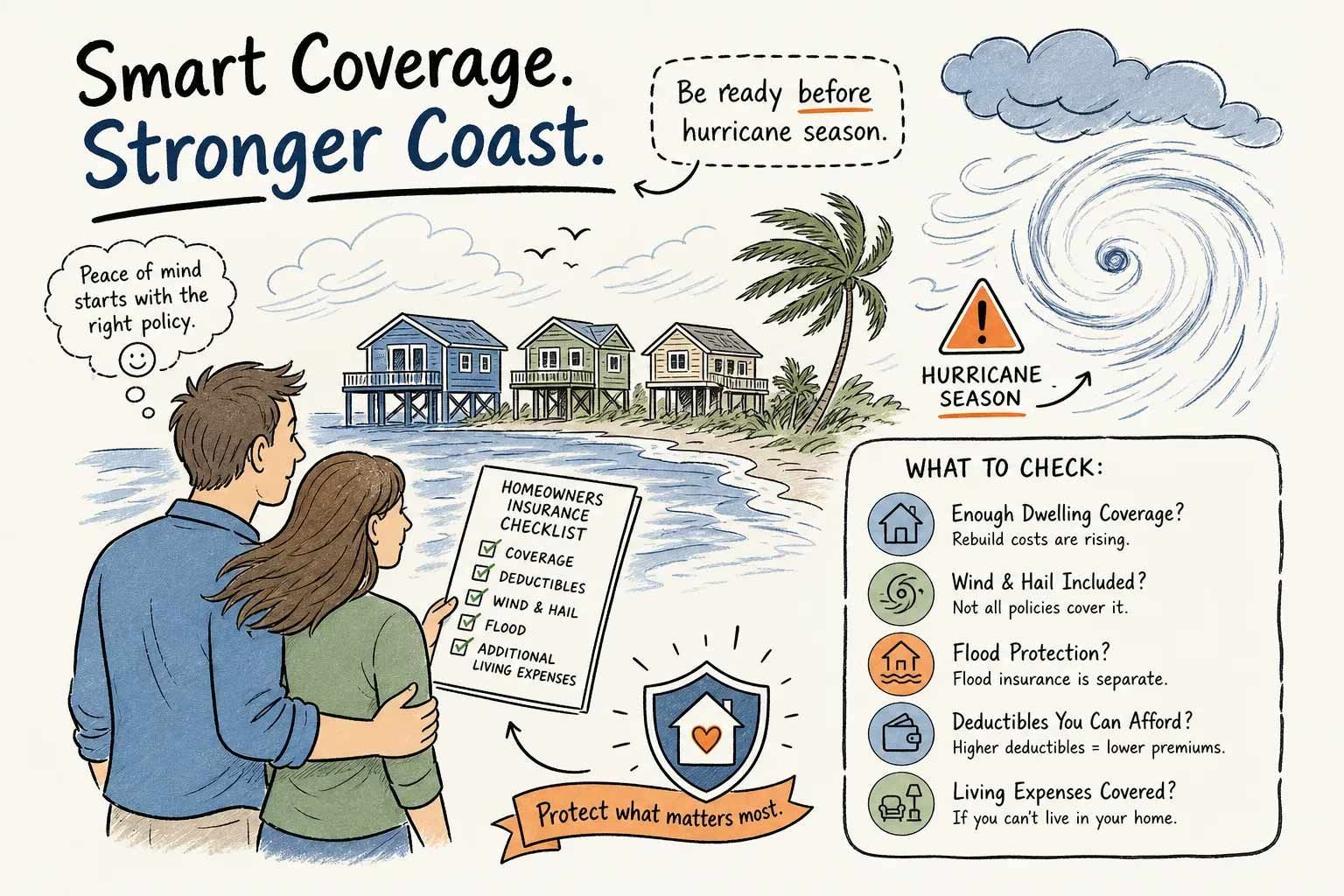
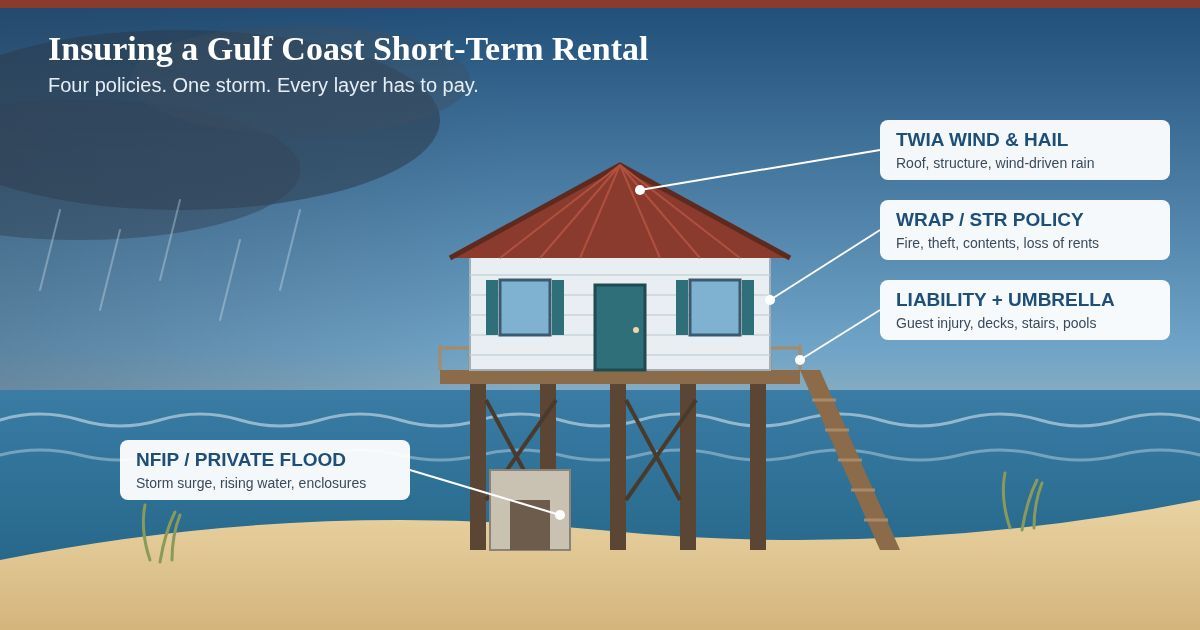
Infographic of a beach house on stilts during a storm, titled “Insuring a Gulf Coast Short-Term Rental.”

Written by Brad Spurgeon, licensed Texas property & casualty agent based on the Gulf Coast. Last updated September 2, 2026.


If you rent a beach house in Galveston, a canal home in Jamaica Beach, a stilt house in Crystal Beach or Surfside, or a condo in Port Aransas on Airbnb or VRBO, your insurance is not one policy. It is a stack of three or four policies from three or four different sources, and every one of them has to be written correctly for the stack to pay when a hurricane comes ashore.


Most of the "Texas short-term rental insurance" online is written by out-of-state agencies that quote all fifty states from one desk. This guide is different. I live and write policies on the Texas Gulf Coast since 1986. Below is exactly how a Gulf Coast short-term rental should be insured, what each piece costs and why, the mistakes I see on policies that come across my desk from other agents, and what happens on claim day when a named storm hits.

Quick Answer: What a Gulf Coast Airbnb or VRBO actually needs

Layer What it covers Who writes it
Wind and hail Hurricane wind, tornado, hail, wind-driven rain that enters through a wind-created opening TWIA in the 14 Tier 1 counties (plus Harris County east of Hwy 146); private wind carriers where available
Storm surge, rising water, flooding from rainfall NFIP or private flood policy Flat dollar, commonly $1,000–$10,000
"Wrap" or ex-wind property policy Fire, lightning, theft, vandalism, pipe bursts, liability, loss of rents, everything *except* wind and hail Standard or specialty carrier on a DP-3 or commercial habitational form, with the wind exclusion endorsement
Flood Storm surge, rising water, flash flooding, rain-driven flooding NFIP (FEMA) policy, plus private excess flood above NFIP limits if needed
Liability Guest injury, third-party property damage, defense costs Included in the wrap policy or a separate commercial GL; umbrella on top for pools, docks and large-occupancy homes
Short-term rental endorsement or STR-specific form Makes the whole thing valid when paying guests are in the house Must be on the Primary policy; TWIA Windstorm & Hail and FEMA flood do not care about the rental use, your Primary commercial or personal TDP-3 Fire Insurance carrier does

Every claim scenario in this article comes back to one of those five lines. If any one of them is missing or written wrong, the whole stack has a hole in it.

Why your standard homeowners or landlord policy will not work

A Texas homeowners policy (HO-3 or HO-5) is written for a house you live in. A landlord policy (DP-3) is written for a house with a long-term tenant under a lease. Neither contemplates a different family with the keys every three nights, a pool full of people who have never seen your pool rules, and a lockbox code that has been texted to two hundred strangers.


Most carriers handle this one of three ways:

  1. Exclude it. Many HO and DP forms carry a "business pursuits" or "rental to others" exclusion that removes liability coverage, and sometimes property coverage, when the home is rented for short terms.
  2. Non-renew you. Carriers routinely find Airbnb and VRBO listings by address. A non-renewal in TWIA territory is a real problem, because the pool of carriers willing to write a wrap policy on the coast is already thin.
  3. Deny at claim time. The worst outcome. A fire caused by a guest's unattended grill, a guest injured on a stairway, a theft of furnishings: all three are routinely denied when the carrier discovers the home was on a rental platform and the policy did not permit it.


The fix is either an STR endorsement on a DP-3 from a carrier that allows it, or a purpose-built short-term rental policy from a specialty carrier. On the Gulf Coast, the specialty form is usually the better answer because it is designed from the start to sit next to a TWIA policy and an NFIP policy.

Layer 1: TWIA windstorm coverage on a short-term rental

The Texas Windstorm Insurance Association writes wind and hail coverage in the 14 first-tier coastal counties, from Cameron County at the Mexico border up through Willacy, Kenedy, Kleberg, Nueces, San Patricio, Aransas, Refugio, Calhoun, Matagorda, Brazoria, Galveston, Chambers and Jefferson, plus the portion of Harris County east of Highway 146 (Baytown, La Porte, Seabrook, Kemah, Shore Acres). If your rental is in one of those areas, TWIA is very likely your wind carrier.

What Gulf Coast rental owners need to know about TWIA

TWIA does not care that it is a rental. TWIA writes the structure and contents for wind and hail. It does not ask about occupancy type in the way your wrap carrier does. That is good news, but it also means TWIA does not provide liability, loss of rents, or coverage for any other peril.


TWIA has a maximum limit. TWIA's maximum limit for a dwelling or individually owned townhouse is currently $1,773,000 (per the [TWIA Q1 2026 Fact Book](https://www.twia.org/wp-content/uploads/Q1-2026-TWIA-Fact-Book.pdf)), and the limit is adjusted for inflation each year. Higher-value beachfront homes on Galveston's West End or in Port Aransas need excess wind coverage above the TWIA cap, usually from a surplus-lines market.


The WPI-8 certificate is the gate. Any new construction, addition, repair, or alteration since 1988 has to have a Certificate of Compliance (the WPI-8, or WPI-8-C for TDI-certified work) proving it was built to the coastal windstorm building code. No certificate, no TWIA coverage on that portion of the structure. Buying an existing rental? Ask for the certificates before you close, not after. I see investors buy a house, list it, and then discover the previous owner's deck, roof or garage conversion was never certified. WPI-8 search link; https://appscenter.tdi.texas.gov/windstorm/p/searchForAppl


Percentage deductibles. TWIA residential policies carry a percentage deductible on the dwelling limit (commonly 1% to 5%, though options vary). On a $600,000 beach house with a 2% deductible, you are absorbing the first $12,000 of a wind claim. Build that number into your reserve.


The Adjusted Building Cost dwelling endorsement raises your limit every year.** Coverage A limits are increasing by roughly 3% for renewals effective on or after September 1, 2026, under TWIA's automatic adjusted building cost endorsement ([TWIA notice](https://www.twia.org/twia-automatic-adjusted-building-cost-abc-endorsement/)). That helps, but it is an inflation adjustment, not a replacement-cost guarantee. Coastal construction costs have run ahead of the index in several recent years. Have your replacement cost re-estimated after any major storm season.


Loss of use on TWIA is limited. TWIA offers Additional Living Expense on owner-occupied dwellings, but on a rental what you actually need is *loss of rental income*, and that comes from your wrap policy or STR policy, not TWIA. More on this below because it is the single most common gap I see.

Private wind instead of TWIA

Some Gulf Coast rentals, especially newer construction with full WPI-8 documentation and a fortified roof, can find wind coverage in the private market or through TWIA's depopulation program, where private carriers take over TWIA policies. The private option can be cheaper and can bundle wind back into the wrap policy so you have one fewer carrier at claim time. Whether it is available depends on the specific address, construction and roof age, and it changes year to year. It is worth asking every renewal.

Layer 2: The Primary Commercial Fire & Liability policy (everything except wind and flood)

This is the policy that makes or breaks a coastal short-term rental. It has to do four things at once:

  1. Exclude wind and hail (so it dovetails with TWIA instead of double-covering)and Floods
  2. Cover every other peril: fire, lightning, theft, vandalism, sudden pipe bursts, and interior water damage that do not come through a wind-created opening or rising water
  3. Explicitly permit short-term rental use
  4. Carry liability and loss of rents

Coverage points I check on every Gulf Coast STR commercial policy

Replacement cost on the dwelling, not actual cash value. ACV settlements deduct depreciation. On a 1970s Galveston beach house, that deduction can be enormous.


Contents on replacement cost, with a limit that matches reality. A furnished rental has beds, linens, TVs, a stocked kitchen, patio furniture, kayaks, golf carts. Most owners under-insure contents by half. Walk the house with your phone and film every room; that video is both your contents inventory and your claim documentation.


Loss of rents, with a realistic monthly figure and a realistic period. After Hurricane Ike in 2008, some Bolivar and Galveston rentals were out of service for more than a year. Twelve months of actual rental income is a defensible number for a coastal property. Also confirm the loss-of-rents coverage responds to a *wind* loss even though the primary Fire & Liability policy excludes wind property damage. Some forms do, some require an endorsement, and some do not. This is the number-one gap I find on policies written by agents who do not work the coast.


Civil authority and ingress/egress. When Galveston County issues a mandatory evacuation, or the causeway or the Bolivar ferry is closed, your bookings cancel whether or not your house is damaged. Civil-authority coverage pays lost rents for that period on a properly written policy.


Theft and vandalism by guests. Cheaper STR forms exclude it. Verify.


Ordinance or law. Galveston, Brazoria, and Nueces counties enforce current windstorm and floodplain construction codes on repairs above a threshold. If your 1985 pier-and-beam house is 50% damaged, the county may require the rebuild to be elevated and built to current code. Ordinance or law coverage pays the difference. On pre-FIRM and pre-1988 houses, I treat this as mandatory, not optional.


Equipment breakdown. A/C compressors, pool pumps, and water heaters die in August. Sudden mechanical failure is not covered by a standard property form. This is a cheap endorsement that pays for itself the first time a compressor fails during peak season.

Layer 3: flood insurance (the part everyone skips until it is too late)

Storm surge is a flood, not wind. TWIA will not pay for it. Your Fire & Liability policy will not pay for it. Only a flood policy pays for it, and on the Gulf Coast surge is what destroys ground floors, garages, enclosures below the house, decks and everything stored under a stilt house. And even the whole structure can collapse.

NFIP basics for a Gulf Coast rental

Limits: the NFIP residential building limit is $250,000 and the contents limit is $100,000. On most beach rentals that building limit is below replacement cost, which is why an excess flood policy above NFIP is standard on higher-value properties.


Non-primary residence rates. Under NFIP's Risk Rating 2.0, a property that is not the owner's primary residence pays a higher rate, An extra $200-$250 fee. Rentals are non-primary by definition. The price is what it is, but do not let an agent quote it as primary to make the number look better; NFIP will re-rate, and the difference is back-charged up to 6 years or policy terms.


Enclosures below the base flood elevation. If your stilt house has a "breakaway" enclosure downstairs with a bedroom, kitchenette or laundry, understand that NFIP building coverage below the lowest elevated floor is very limited. Furnishings and finishes down there are largely uninsured. Rent the upstairs, store nothing valuable downstairs.


Contents in a rental. NFIP contents coverage for a non-primary residence is available and worth buying. Your Fire & Liability policy's contents coverage excludes flood.


30-day waiting period.  A new NFIP policy generally has a 30-day wait unless it is tied to a loan closing. Do not wait until a storm is in the Gulf. By then, it is too late.


The Elevation Certificate still matters. Risk Rating 2.0 does not require one, but a favorable EC can lower the premium, and you will need it for any future elevation or mitigation work.

Private flood

Private flood carriers write higher building limits, replacement cost on contents, loss-of-rents for flood (NFIP does not offer it), and sometimes shorter waiting periods. For a beachfront rental worth more than $250,000, the standard structure is NFIP as the primary layer and a private excess policy stacked above it, or in some cases a private primary flood policy that replaces NFIP entirely. Lender requirements and long-term price stability drive which one is right.

Layer 4: Liability and Umbrella

A guest injury claim is the loss most likely to end a rental business. Pools, hot tubs, elevated decks, exterior stairs, boat docks, kayaks, golf carts and beach access all concentrate liability on Gulf Coast rentals.


Minimum $1,000,000 per occurrence on the STR policy's liability or a separate commercial general liability form.

Umbrella of $1,000,000 to $5,000,000 on any property with a pool, hot tub, dock or capacity above ten guests. Umbrellas are inexpensive relative to the limit.

Watercraft and golf carts. Providing a kayak, paddleboard or golf cart for guest use is usually excluded from the base liability form. It has to be endorsed or separately insured.

Liquor liability. If you stock a welcome bottle of wine, most STR policies treat that as incidental. If you host events with an open bar, it is not.

Cancellation and platform coverage is not insurance. Airbnb's AirCover and VRBO's host protections are goodwill programs with exclusions, caps, and no duty to defend you in a lawsuit. They are a backstop, not a policy.

What a real Gulf Coast claim looks like

Scenario: Category 2 hurricane makes landfall near Freeport. A Surfside Beach stilt house takes roof damage, the downstairs enclosure floods with three feet of surge, wind-driven rain gets through the roof and ruins the upstairs living room, and the county closes the island for nine days.


Here is who pays for what:

Damage Policy that responds
Roof, siding, windows TWIA (minus the percentage deductible)
Interior water damage through the roof opening TWIA (wind-driven rain through a wind-created opening)
Downstairs surge damage NFIP building (limited below BFE) and contents
Upstairs furniture ruined by surge? Not applicable, surge did not reach upstairs; if it had, NFIP contents
Lost bookings during the nine-day closure Wrap policy civil-authority / loss of rents
Lost bookings during the four-month rebuild Wrap policy loss of rents (if written to respond to wind loss)
County requires elevating the enclosure on rebuild Ordinance or law on the wrap policy
Spoiled contents of the freezer Wrap policy, if refrigerated-property endorsement is on it

Three carriers, three adjusters, three claim numbers. A local agent who has worked Ike, Harvey, Laura, Nicholas and Beryl claims knows how to sequence those adjusters so that the wind adjuster and the flood adjuster do not each blame the other for the same ruined drywall.

Local rules that affect your policy

Galveston. The city requires short-term rental registration and hotel occupancy tax remittance. Registration and tax compliance is increasingly requested by carriers at application.


Galveston County, Brazoria County, Bolivar Peninsula, Surfside. Unincorporated areas have lighter STR rules but strict floodplain and windstorm construction enforcement through the county engineer and TDI.


Port Aransas and Nueces County. Port Aransas has an STR permit and occupancy-tax program. Post-Harvey rebuilds are heavily WPI-8 documented, which helps on wind placement.


Rockport-Fulton and Aransas County. Still recovering housing stock from Harvey; roof age and certification are the first two underwriting questions.


South Padre Island and Cameron County. Condo-heavy market. For a condo unit, the association's master policy handles the building's TWIA and flood; the unit owner needs an HO-6-style STR policy for interior finishes, contents, loss assessment and liability, plus an NFIP contents policy.


Hotel occupancy tax runs 6% at the state level plus local rates; Airbnb and VRBO remit some but not all of it depending on jurisdiction. Keep your own records.

What Gulf Coast short-term rental insurance costs

Every property is different, but the drivers are consistent and here is what moves the number most, in order:

  1. Distance to the coast and flood zone (VE and AE zones cost more than X)
  2. Roof age, roof type and WPI-8 documentation
  3. Year built** (pre-1988 and pre-FIRM homes are hardest to place)
  4. Replacement cost (larger, newer beachfront homes exceed the TWIA and NFIP caps and need excess layers)
  5. Amenities (pool, hot tub, dock, elevator, golf cart)
  6. Claims history on the property, not just on you
  7. Elevation relative to base flood elevation


A realistic all-in annual budget for a mid-range Galveston or Bolivar beach rental, counting TWIA, wrap policy, NFIP and umbrella, is a meaningful line item that belongs in your pro forma before you buy, not after. If an agent gives you a single number without asking about your roof, your WPI-8s, and your flood zone, they have not actually quoted the property.

Mistakes I fix on policies from out-of-area agents

  1. Loss of rents that does not respond to wind loss because the wrap policy excludes wind, and nobody endorsed the income coverage back on.
  2. No flood policy at all, or NFIP rated as a primary residence.
  3. Dwelling limit on the wrap policy set to match TWIA's capped limit rather than actual replacement cost.
  4. Missing WPI-8 certificates on additions, discovered only at claim time.
  5. HO-3 with an "occasional rental" endorsement on a house that rents 200 nights a year.
  6. Contents at $20,000 on a fully furnished four-bedroom house.
  7. No ordinance or law on a pre-FIRM house.
  8. Pool with a $300,000 liability limit and no umbrella.

How to get a Gulf Coast short-term rental quote from a local agent

Send me the address, the year built, the roof age, any WPI-8 certificates you have, your current declarations pages, your flood zone (or I will pull it), and a rough count of your nightly rate and occupancy. I will come back with a TWIA quote, a Fire & Liability or STR policy quote from carriers that actually write in Tier 1 counties, an NFIP and private flood comparison, and an umbrella option, structured so that all of them pay together after a storm.


Call office
(409) 354-3708 or text my personal cell (409) 354-3708 · Request a Gulf Coast STR quote →


John Bradley Spurgeon is a licensed Texas insurance agent based on the Gulf Coast, specializing in homeowners, TWIA windstorm and hail, and FEMA flood insurance for coastal properties from Bolivar to South Padre.


Brad Spurgeon Insurance Agency Inc.

Texas license #16829

Frequently asked questions

  • Does TWIA cover Airbnb and VRBO rentals?

    Yes. TWIA insures the structure and contents against wind and hail regardless of rental use. It does not provide liability, loss of rents, flood or any non-wind peril; those come from your wrap policy and NFIP.

  • Do I need a separate flood policy for a beach rental in Texas?

    Yes. Neither TWIA nor any property policy covers storm surge or rising water. An NFIP policy is the base layer, with private excess flood above it for properties worth more than the $250,000 NFIP building limit.

  • Can I keep my homeowners policy and just add a rental endorsement?

    Only for genuinely occasional rentals, and only with carriers that offer it. A home rented most weekends needs a DP-3 with a short-term rental endorsement or a purpose-built STR policy.

  • Does Airbnb's AirCover replace insurance?

    No. Host protection programs have exclusions, caps and no duty to defend. Carriers and courts treat them as a backstop, not as primary coverage.

  • What is a WPI-8 and why does my agent keep asking for it?

    It is the TDI Certificate of Compliance proving construction meets the coastal windstorm code. TWIA requires it for any construction, addition or repair since 1988. Without it, that part of the structure is ineligible for TWIA wind coverage.

  • How much loss of rents should I carry?

    Twelve months of actual gross rental income is the defensible number on a coastal property, and it must be written to respond to wind losses even though your wrap policy excludes wind damage to the structure.

  • I own a condo in Port Aransas or South Padre. What do I need?

    The association's master policy covers the building's wind and flood. You need an HO-6-style short-term rental policy for interior finishes, contents, loss assessment and liability, plus an NFIP contents policy in your name.


  • When is the deadline to buy flood insurance before hurricane season?

    NFIP has a 30-day waiting period. Bind by early May to be covered by June 1, and never wait for a storm to enter the Gulf.

  • Can I get wind coverage without TWIA?

    Sometimes. Newer, fully certified construction with a good roof may qualify for private wind or a TWIA depopulation offer. Availability changes each year, so ask at every renewal.


This article is general information about insurance products available in Texas and is not a policy, a binder or a guarantee of coverage. Coverage is determined by the terms of the actual policy issued. Contact a licensed agent to discuss your specific property.

Home, homeowners, and flood policy comparison over a flooded house illustration
September 7, 2026
How Texas coastal homeowners actually get hurricane coverage: TWIA 2026 limits, the declination rule, WPI-8 certificates, named-storm deductibles, and the flood policy that pays for surge. Written by a Gulf Coast agent.
August 25, 2026
Learn why TWIA requires WPI-8 certification, which Texas coastal homes need it, key exceptions, and what to do if your certificate is missing.
A smiling parent sits on a couch and lifts a happy young child
August 19, 2026
Kids explore everything, and that curiosity is part of what makes childhood fun — but it also means everyday spaces in your home can hide risks you might not think twice about as an adult. A few thoughtful changes around the house can prevent the kinds of accidents that send families to the emergency room every year.
A view of two suburban houses
August 17, 2026
It's a question we hear often in Texas City, especially once a tropical system starts showing up in the forecast: can I still get flood insurance now, or is it too late? The honest answer is that it depends on your policy type and timing, and understanding how flood insurance waiting periods work can save you from a co
An American Red Cross emergency kit with supplies like water, a flashlight, goggles, and a poncho for flood survival.
August 10, 2026
Living near the Texas Gulf Coast means flooding isn't a rare or distant threat — it's a real possibility every hurricane season, and sometimes even after a heavy afternoon thunderstorm. Whether you're right along the water or a few miles inland, knowing how to prepare, evacuate, and recover safely can make all the diff
Two people holding hands while walking along a paved path in a sunlit park.
By Brad Spurgeon August 4, 2026
Explore activities like dancing, gardening, & yoga to keep seniors healthy. Contact us for tailored insurance solutions today!
A suburban street with modern houses against a mountain backdrop
August 4, 2026
Learn 9 ways to protect your home from windstorms. Ensure safety & get windstorm insurance. Contact Brad Spurgeon Insurance Agency today!
A brown shingled home with a wrap-around porch, featuring text overlays about roofing maintenance and home insurance.
By Brad Spurgeon August 4, 2026
Learn 4 roofing maintenance tips to protect your home. Update your home insurance for better coverage. Contact Brad Spurgeon Insurance Agency today!
Close-up of a white car parked on gravel, with text at the bottom asking,
August 4, 2026
Understand when to inflate your tires for safety & efficiency. Contact Brad Spurgeon Insurance Agency for your insurance needs.
Flood water surrounds buildings under a bridge. Brown water, trees, and houses are visible.
August 4, 2026
Learn essential tips for flash flood safety, including preparation & recovery. Contact Brad Spurgeon Insurance Agency for flood insurance solutions.
Show More