

Home Insurance Riders: Customizing Your Coverage

February 5, 2024
A bright, modern living room with gray furniture

​

When it comes to protecting your home and belongings, a standard homeowners insurance policy provides essential coverage. However, every homeowner's needs are unique, and sometimes the standard coverage might not be sufficient. That's where home insurance riders come into play. These optional add-ons allow you to customize your coverage to suit your specific requirements. In this blog, we'll explore home insurance riders, what they are, and how they can help you tailor your insurance policy to provide comprehensive protection.


Understanding Home Insurance Riders

Home insurance riders, also known as endorsements or floaters, are additional coverages that can be attached to your standard homeowners insurance policy. They serve to extend or modify the coverage provided by your base policy. The primary purpose of riders is to address specific risks or add protection for high-value items that may not be adequately covered by your standard policy.


Common Home Insurance Riders

  1. Scheduled Personal Property Rider : This rider allows you to specifically list and insure high-value items like jewelry, artwork, antiques, or collectibles. It provides broader coverage and often covers items for their full appraised value.

  2. Flood Insurance Rider: Many standard homeowners policies do not cover flood damage. If you live in a flood-prone area, a flood insurance rider can provide the necessary protection.

  3. Earthquake Insurance Rider: Like flood insurance, earthquake damage is typically excluded from standard policies. An earthquake insurance rider is essential for those residing in seismic zones.

  4. Home Business Rider: If you operate a business from your home, standard homeowners insurance may not cover business-related liability or property damage. This rider can fill the gap.

  5. Backup of Sewers and Drains Rider: This rider provides coverage for damage caused by the backup of sewers and drains, which is typically excluded from standard policies.

  6. Identity Theft Rider: In the age of digital threats, an identity theft rider can help cover expenses related to identity theft recovery, such as legal fees and credit monitoring.

  7. Extended Replacement Cost Rider: While standard policies cover the replacement cost of your home, this rider extends the coverage limit to ensure you can rebuild even if construction costs have risen significantly.

Customizing Your Coverage

To customize your home insurance coverage effectively, consider the following steps:


  1. Assess Your Needs: Evaluate your specific risks and possessions that may require additional coverage. For instance, if you have valuable jewelry or live in an area prone to natural disasters, you may need corresponding riders.

  2. Talk to Your Insurance Agent: Consult with your insurance agent to discuss your requirements. They can recommend the appropriate riders and provide cost estimates.

  3. Review Costs and Benefits: Carefully review the cost of each rider against the potential benefits it offers. Some riders may be more cost-effective than others based on your circumstances.

  4. Update Your Policy: Once you've selected the riders that suit your needs, update your homeowners insurance policy to include them. Your agent will guide you through the process.

In Conclusion

Home insurance riders are a valuable tool for homeowners seeking to customize their coverage to match their unique needs and circumstances. They provide the flexibility to add specific protections and ensure that you are adequately covered in case of unexpected events or losses. By assessing your needs, consulting with your insurance agent, and selecting the right riders, you can create a tailored insurance policy that offers comprehensive protection for your home and belongings. Don't hesitate to explore these options to achieve peace of mind and financial security for your home.


At Brad Spurgeon Insurance Agency Inc., we aim to provide comprehensive insurance policies that make your life easier. We want to help you get insurance that fits your needs. You can get more information about our products and services by calling our agency at (409) 945-4746. Get your free quote today by CLICKING HERE. 


Disclaimer: The information presented in this blog is intended for informational purposes only and should not be considered as professional advice. It is crucial to consult with a qualified insurance agent or professional for personalized advice tailored to your specific circumstances. They can provide expert guidance and help you make informed decisions regarding your insurance needs.

September 15, 2026
If you own a home in Texas City, you already know windstorm insurance isn't optional, and you've probably felt the sting of the premium on your renewal notice. Years of active hurricane seasons along the Gulf have pushed rates higher across the board, but that doesn't mean you're stuck accepting whatever number your ca
A damaged, peeling wall with dark mold growth
September 9, 2026
Mold has a way of showing up in Texas City homes when you least expect it, and Gulf Coast humidity doesn't make it any easier to avoid. Between hurricane-season moisture, everyday humidity, and the occasional leaky pipe or roof, it's one of the more common issues local homeowners run into, and also one of the more misu

September 9, 2026
Owning a home along the Texas Gulf Coast means living with a level of risk most inland homeowners never think twice about. Between hurricane season, hail storms rolling in off the Gulf, and the ever-present threat of flooding after a heavy rain, a homeowners policy here has to work harder than it does almost anywhere e
September 9, 2026
Most Texas City homeowners assume that if their house takes on water, their homeowners policy has them covered. It doesn't, and finding that out mid-claim is one of the most expensive surprises a Gulf Coast homeowner can face. Flood damage is excluded from every standard homeowners and commercial property policy in the
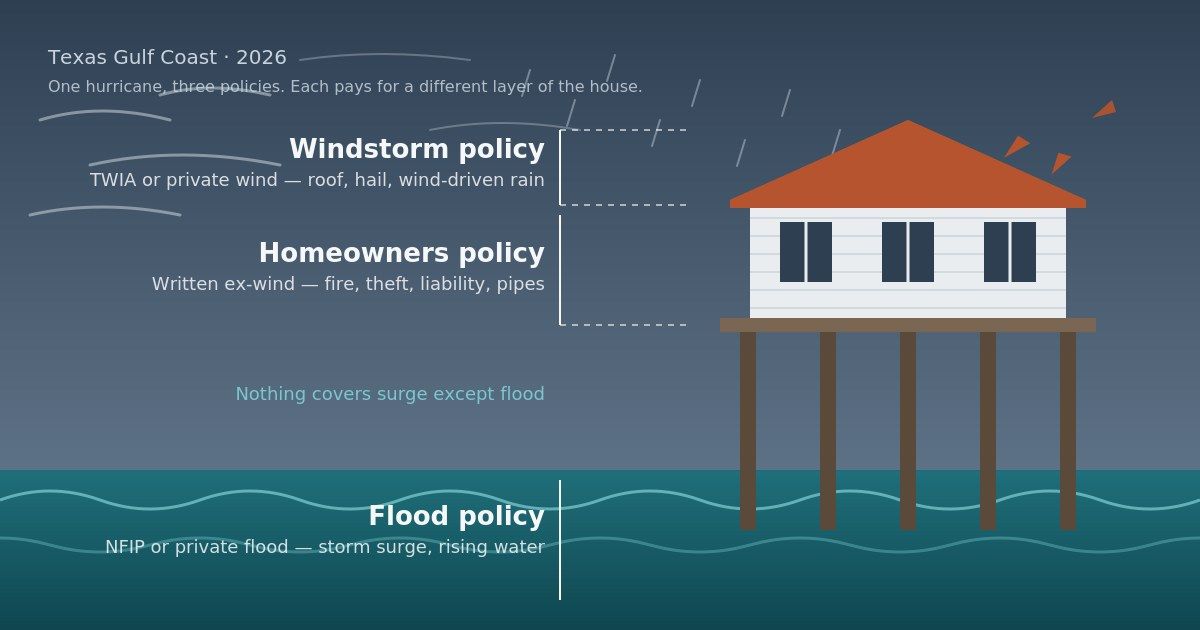
Home, homeowners, and flood policy comparison over a flooded house illustration
September 7, 2026
How Texas coastal homeowners actually get hurricane coverage: TWIA 2026 limits, the declination rule, WPI-8 certificates, named-storm deductibles, and the flood policy that pays for surge. Written by a Gulf Coast agent.
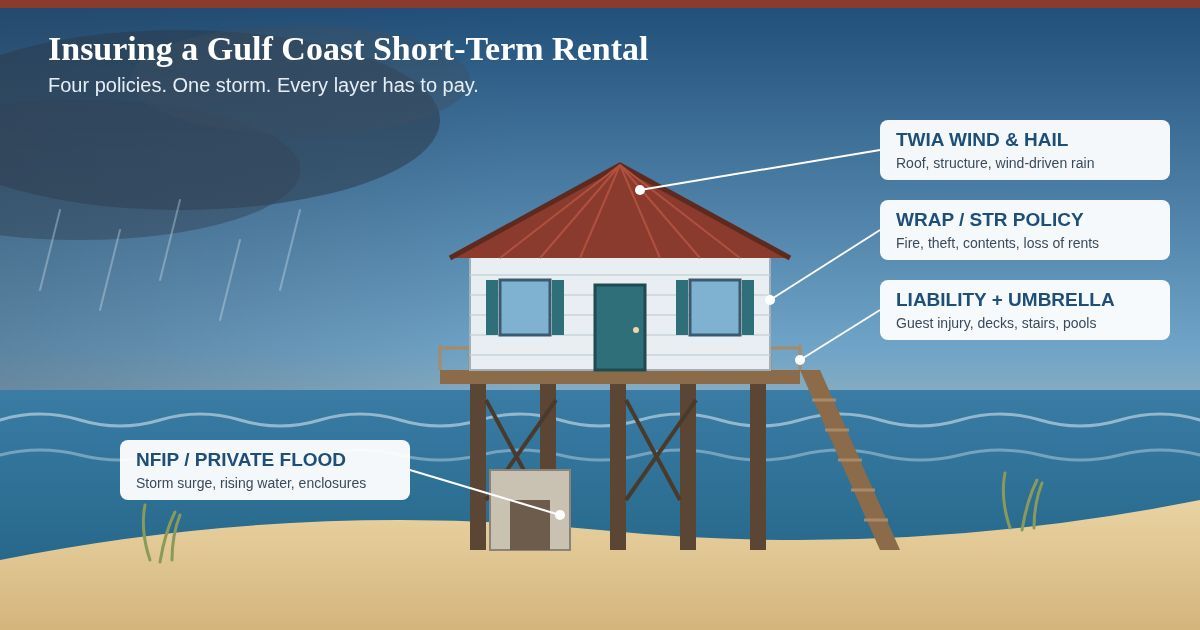
Flooded beach house on stilts with roof damage and insurance claim callouts about a Gulf Coast short-term rental
September 7, 2026
How to insure a Galveston, Crystal Beach, Surfside, or Port Aransas short-term rental: TWIA wind, NFIP flood, Fire & Liability policy, from an experienced local Gulf Coast Insurance agent.
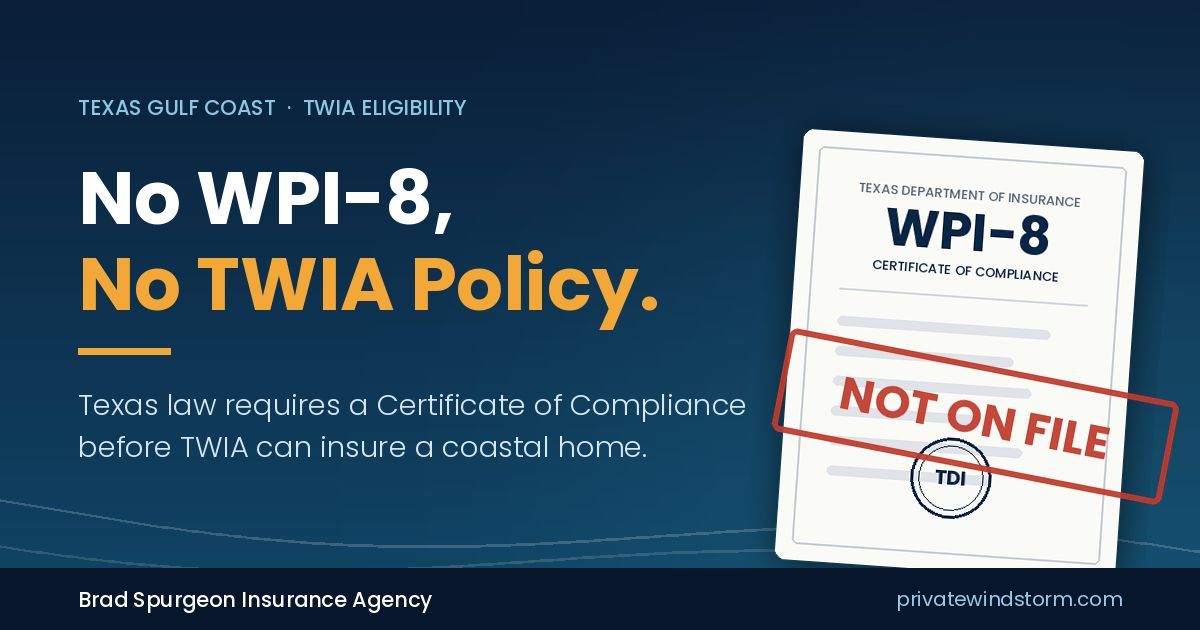
August 25, 2026
Learn why TWIA requires WPI-8 certification, which Texas coastal homes need it, key exceptions, and what to do if your certificate is missing.

A smiling parent sits on a couch and lifts a happy young child
August 19, 2026
Kids explore everything, and that curiosity is part of what makes childhood fun — but it also means everyday spaces in your home can hide risks you might not think twice about as an adult. A few thoughtful changes around the house can prevent the kinds of accidents that send families to the emergency room every year.
A view of two suburban houses
August 17, 2026
It's a question we hear often in Texas City, especially once a tropical system starts showing up in the forecast: can I still get flood insurance now, or is it too late? The honest answer is that it depends on your policy type and timing, and understanding how flood insurance waiting periods work can save you from a co
An American Red Cross emergency kit with supplies like water, a flashlight, goggles, and a poncho for flood survival.
August 10, 2026
Living near the Texas Gulf Coast means flooding isn't a rare or distant threat — it's a real possibility every hurricane season, and sometimes even after a heavy afternoon thunderstorm. Whether you're right along the water or a few miles inland, knowing how to prepare, evacuate, and recover safely can make all the diff
Show More