Short-Term Rental Insurance & Liability Requirements in Galveston and Jamaica Beach, Texas (2026 Guide)

July 1, 2026

Short-Term Rental Insurance & Liability Requirements in Galveston and Jamaica Beach, Texas


If you own a vacation rental on Galveston Island or in the nearby city of Jamaica Beach, insurance isn't just a smart precaution—it is now a legal mandate enforced by the local government in one of these two markets. This guide breaks down exactly what short-term rental insurance in Texas looks like for Gulf Coast property owners, how Galveston vacation rental liability rules differ from Jamaica Beach STR insurance requirements, and what coverage you actually need to operate legally and protect your investment.


Texas has no statewide short-term rental (STR) license or insurance law. Every city sets its own rules, and Galveston and Jamaica Beach—though just a few miles apart on the same island—have taken noticeably different approaches. Understanding both is essential if you own, or are considering buying, an STR anywhere on Galveston Island. Because coastal property always carries windstorm and flood exposure on top of city liability rules, it's worth working with a Texas Gulf Coast insurance agency that understands both the regulatory side and the coverage side of running a vacation rental here.

Quick Comparison: Galveston vs. Jamaica Beach STR Insurance Rules

Requirement City of Galveston Jamaica Beach
STR registration required Yes (since 2015, Ordinance 15-012) Yes (Ordinance 2026-01)
Mandatory liability insurance amount Not explicitly codified in the ordinance; insurance documentation referenced in licensing materials $1,000,000 general liability, explicitly required by ordinance
Registering authority City of Galveston (as of Oct. 1, 2025; previously the Park Board) City of Jamaica Beach
registration/operation fee $250 Set by council resolution; historically $150–$250 range
Occupancy cap Not specified in ordinance; building/fire code applies 12-person cap (upheld in 2026 litigation)
Local 24/7 contact required Yes Yes
Hotel Occupancy Tax 9% local HOT + state HOT Local HOT + state HOT
Where STRs are banned R-0 zoning district only Subject to ordinance specifics; check current zoning

Because the two cities don't always update simultaneously, always verify current figures with the relevant city office beforeapplying.

Galveston Vacation Rental Liability: What the Ordinance Actually Requires

The City of Galveston has regulated short-term rentals since 2015 under Ordinance 15-012, with subsequent amendments — including Ordinance 21-021, which created the requirement to display a Galveston Vacation Rental (GVR) registration number on every listing and advertisement. In March 2025, the City Council moved responsibility for short-term rental registration and Hotel Occupancy Tax collection to the City of Galveston itself, effective October 1, 2025.


A few key facts every Galveston STR owner should know:

  • Registration is mandatory. Any dwelling unit rented for fewer than 30 consecutive days is classified as a short-term rental and must register and pay applicable Hotel Occupancy Tax under Ordinance 15-012.
  • Zoning is broad but not unlimited. Short-term rentals are currently allowed in every zoning district on the island except the R-0 district.
  • The GVR number must appear everywhere. Owners and property managers must display their GVR number on all advertisements, including booking platforms, management company websites, and private listings such as Facebook or Instagram, and platforms are required to remove non-compliant listings.
  • Penalties are real. Failure to comply with STR registration or Hotel Occupancy Tax payment requirements is a Class C misdemeanor, punishable by a fine of up to $500 per offense.
  • A licensing board now has teeth. Under the most recent ordinance updates, a new STR licensing board can recommend revocation of a license after three violations within 12 months, with the city manager and City Council making the final call.

Does Galveston require a specific insurance amount?

This is where many owners get tripped up. Unlike Jamaica Beach, Galveston's STR ordinance does not currently spell out a specific minimum liability insurance amount in city code. However, licensing guidance and application materials reference the need for a certificate of insurance demonstrating sufficient liability coverage as part of the application process, alongside tax registration and safety compliance documentation.


Because the city hasn't published a hard dollar figure, the prevailing industry guidance — echoed by Galveston-focused STR resources — is to treat $1 million in general liability coverage as the practical floor, alongside property insurance that explicitly covers short-term rental activity, since this is rapidly becoming the regional standard (and is now the literal legal minimum next door in Jamaica Beach). Galveston's occupancy limits also aren't spelled out in the ordinance itself, so the safe approach is to size your coverage and guest caps to applicable building- and fire-safety code occupancy standards rather than guessing.


Bottom line for Galveston owners: confirm current insurance documentation requirements directly with the City of Galveston's STR registration office before your renewal, since this is an area of city policy that has moved (and could move again) following the city's 2025 takeover of the registration program. A landlord insurance policy built for rental property — rather than a standard owner-occupied homeowners policy — is the right starting point for getting your certificate of insurance in order.

Jamaica Beach STR Insurance: The $1 Million Requirement, Explained

Jamaica Beach has taken a markedly more prescriptive approach than its larger neighbor. The city's current framework, Ordinance 2026-01, repealed and replaced the prior Ordinance 2025-03 and established what city officials describe as comprehensive regulation, registration, and enforcement for short-term rentals.


The headline requirement: a $1,000,000 general liability insurance policy is now mandatory for every Jamaica Beach short-term rental. This was confirmed not only in ordinance text but in a 2026 federal court ruling that tested the ordinance's legality.

The 2026 lawsuit and what it means for owners

A group calling itself the Jamaica Beach Short Term Rental Association, along with four homeowners, sued the city over the new ordinance, arguing it unlawfully restricted their property rights and business operations. In May 2026, a federal judge issued a mixed ruling:


  • The court rejected most of the plaintiffs' claims, including challenges to the 12-person occupancy cap, the $1 million insurance requirement, and the city's enforcement mechanisms, finding these provisions rationally tied to legitimate government interests such as public safety and nuisance control.
  • However, the judge found that a separate restriction on first-floor rental space likely violates the Texas Constitution's prohibition on retroactive laws, since it prevents owners from marketing or fully using portions of homes that had previously been used for rentals.
  • The city is temporarily barred from enforcing the first-floor restriction against the named plaintiffs specifically, while the rest of the ordinance — including the insurance mandate — remains fully in effect.


In practical terms: the $1 million liability insurance requirement is not going away. It has already survived a constitutional challenge in federal court. If you operate an STR in Jamaica Beach, this is a compliance non-negotiable, not a guideline.

Why some owners are pushing back

During public comment, at least one Jamaica Beach STR owner raised a substantive concern worth noting: the ordinance's interpretation excludes coverage provided through established accommodation protection programs (such as host-side guarantee programs offered by booking platforms), meaning a standalone $1 million general liability policy is required even if an owner already carries layered coverage through windstorm, flood, hazard, and a property manager's liability program. If you're relying on a platform's built-in host guarantee or your property manager's umbrella policy, confirm in writing that it satisfies the specific Jamaica Beach ordinance language — don't assume it automatically qualifies. An umbrella insurance policy layered on top of a dedicated rental liability policy is one straightforward way to clear the $1 million threshold with documentation a city will accept.

Other Jamaica Beach STR requirements bundled with insurance compliance

  • Occupancy cap: 12 persons maximum, upheld by the court as enforceable.
  • Registration and renewal: annual registration certificate, with the registration number required on all listings, per amendments including Ordinance 2024-09's platform-compliance language.
  • 24/7 local contact: owners must designate a contact person who can respond to complaints, similar to Galveston's requirement.
  • Hotel Occupancy Tax: city and state HOT obligations apply, with platforms increasingly required to collect and remit on the owner's behalf.

Why "Homeowners Insurance" Isn't Enough for a Texas STR

Whether you're in Galveston, Jamaica Beach, or anywhere else on the Gulf Coast, one fact applies universally: most homeowner's insurance policies exclude coverage for commercial activities, including short-term rentals, which is why STR-specific insurance is essential. A standard HO-3 homeowner's policy is written for owner-occupied, non-commercial use. Renting your property — even occasionally, even through Airbnb or Vrbo — typically falls outside that policy's scope, leaving you exposed exactly when a claim is most likely: during a paying guest's stay.


A guest slip-and-fall, fire damage caused by a renter, theft of guest property, or a liability claim tied to a pool or dock can all fall into a coverage gap if your policy was never designed for transient occupancy. If you currently insure your STR under a standard home insurance policy, it's worth a quick policy review to confirm rental activity is actually covered before your next guest checks in.

What a proper Texas Gulf Coast STR insurance package should include

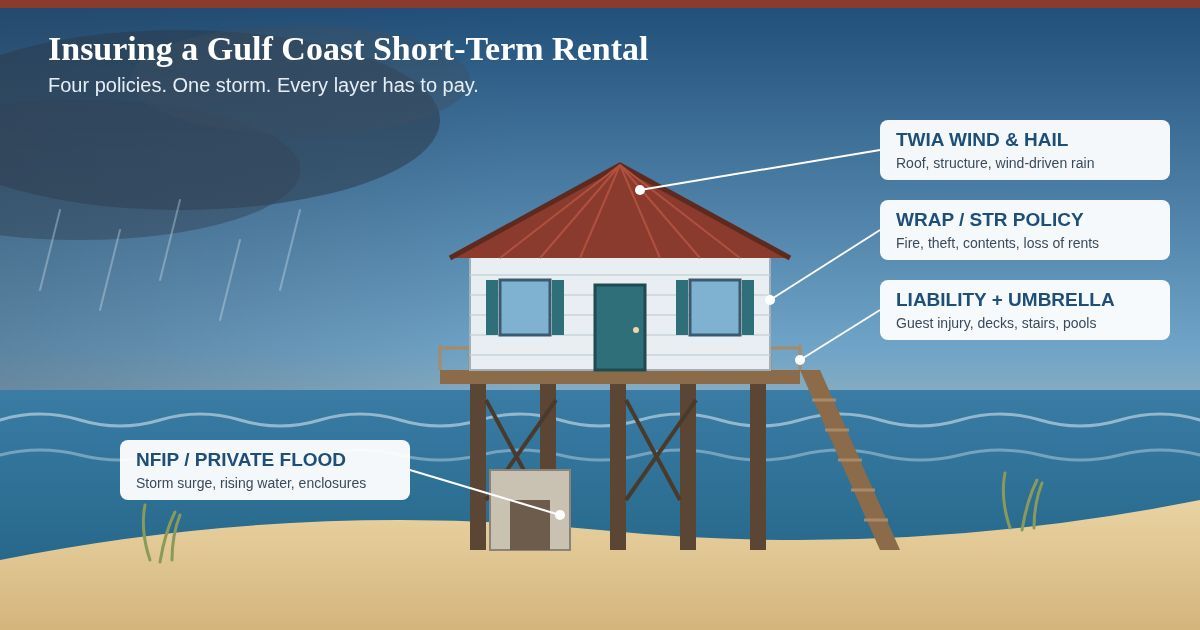
  1. Commercial or short-term rental-specific liability coverage — ideally $1 million or more, given that this is now the legal floor in Jamaica Beach and the de facto market standard across the island. A business insurance policy is often the right vehicle for the commercial-use liability an STR actually needs.
  2. Dwelling/property coverage rated for short-term rental use, not a standard owner-occupied policy — see home insurance and landlord insurance for the relevant options.
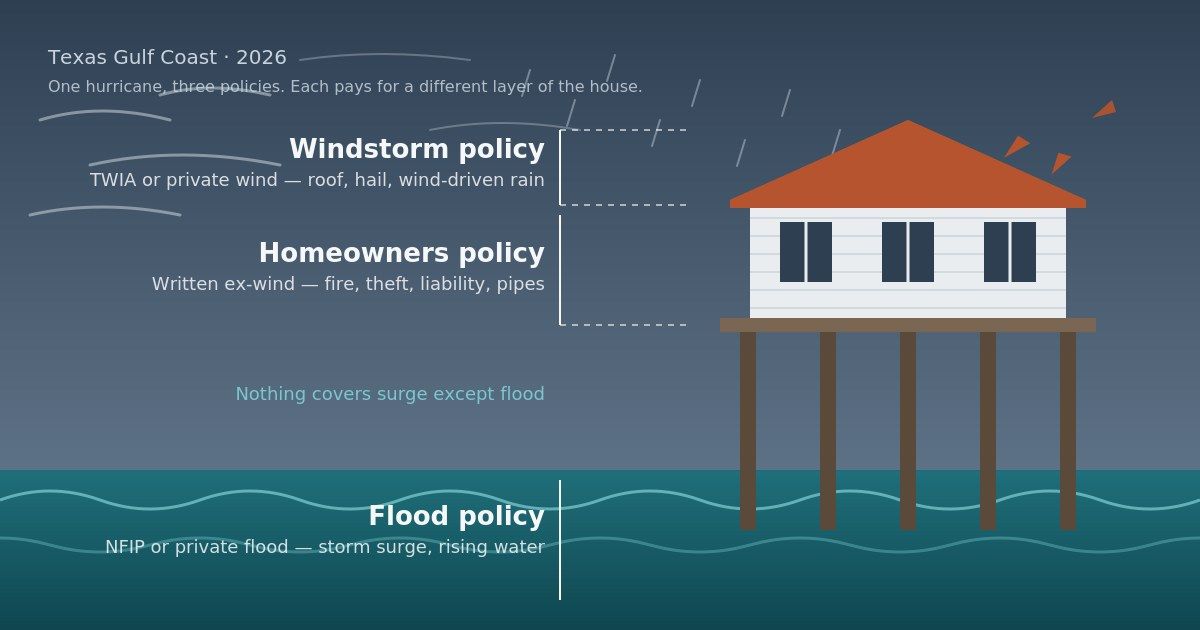
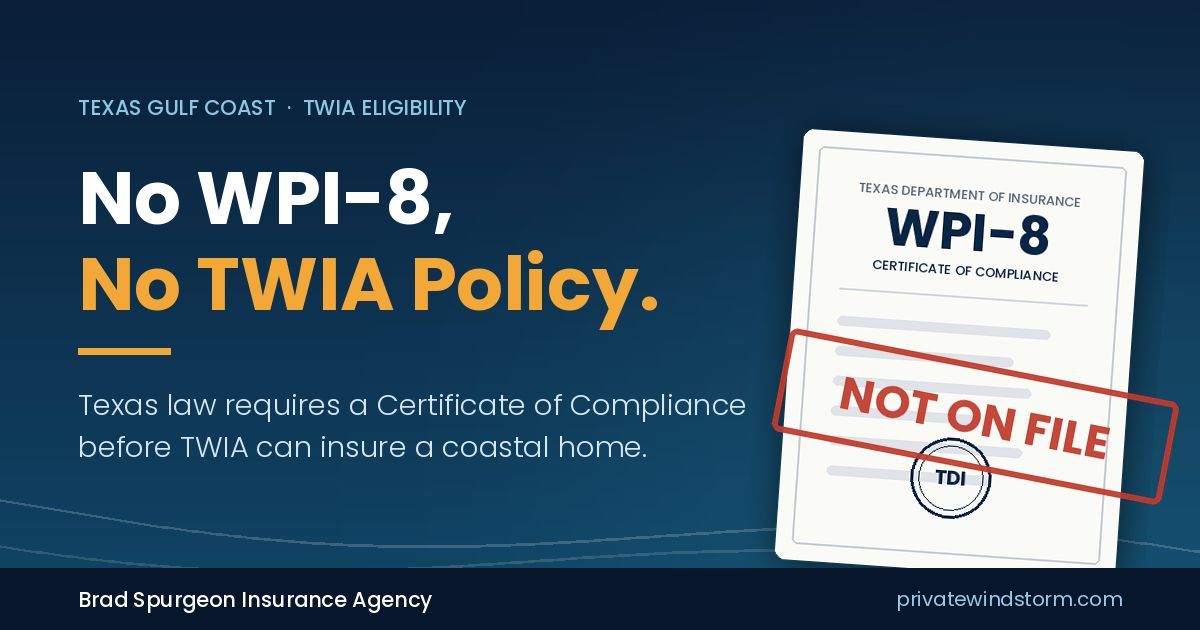
  3. Windstorm and hail coverage, essential for any coastal Galveston County property. Owners can choose between the Texas Windstorm Insurance Association (TWIA) or a private windstorm carrier — private windstorm insurance is increasingly available on the island and worth comparing against TWIA on price and claims service. If your lender or the city requires proof of windstorm coverage, the agency's WPI-8 certificate guide walks through exactly what that certificate is and how to get one issued.
  4. Flood insurance, separate from your windstorm policy, given Galveston Island and Jamaica Beach's flood zone designations and FEMA base flood elevation requirements referenced in Jamaica Beach's own ordinance. See flood insurance for NFIP and private-market options.
  5. Loss-of-income / business interruption coverage, which protects rental revenue if the property becomes uninhabitable after a covered loss — particularly valuable in hurricane-prone markets.
  6. Guest medical payments coverage, which can cover minor injury claims without triggering a full liability claim.

Bundling these correctly — rather than stitching together a homeowners policy, a side liability rider, and a separate windstorm policy from three different carriers — is exactly the kind of coordination an independent agency can help with. Brad Spurgeon Insurance Agency, a third-generation, Texas City-based agency serving Galveston County and the broader Texas Gulf Coast since 1986, works directly with STR owners on this kind of layered coverage; you can request a quote or book a free consultation to review what your specific property needs.

A note on legal and insurance advice

This article is intended as general, informational guidance for Galveston-area property owners and is not legal or insurance advice. Insurance minimums, ordinance language, and enforcement posture can change — as Jamaica Beach's did materially between 2023 and 2026 — so always confirm current requirements directly with the City of Galveston STR office, the City of Jamaica Beach, and a Texas-licensed insurance agent familiar with coastal STR risk before binding a policy or finalizing your registration.

Frequently Asked Questions

  • Does Texas require short-term rental insurance statewide?

    No. Texas has no statewide STR licensing or insurance mandate; regulation happens at the city level, which is why Galveston and Jamaica Beach rules differ even though they're neighbors.

  • How much liability insurance do I need for a Jamaica Beach short-term rental?

    Jamaica Beach Ordinance 2026-01 requires $1,000,000 in general liability insurance, a requirement that was upheld by a federal judge in May 2026 against a legal challenge from local STR owners.

  • Is liability insurance legally required to operate an STR in Galveston?

    The City of Galveston's STR ordinance does not publish a specific minimum dollar amount in code, though insurance documentation is part of standard licensing materials. Many owners and managers treat $1 million in coverage as the practical standard, consistent with the regional norm now codified in Jamaica Beach.

  • Will my Airbnb or Vrbo host guarantee satisfy these local insurance requirements?

    Not necessarily. At least one Jamaica Beach owner has reported that platform-based protection programs were excluded from satisfying the city's $1 million requirement under current interpretation. Confirm directly with the city whether your specific coverage source qualifies.

  • What happens if I operate an STR in Galveston or Jamaica Beach without proper registration?

    In Galveston, failure to register or remit Hotel Occupancy Tax is a Class C misdemeanor punishable by a fine of up to $500 per offense, and non-compliant listings can be removed from booking platforms. Jamaica Beach enforces its own registration, fee, and revocation process under Ordinance 2026-01.

  • Should I use TWIA or private windstorm insurance for my Galveston STR?

    Both are valid options for coastal Texas properties. TWIA is the state-backed insurer of last resort, while private windstorm carriers can sometimes offer more competitive pricing or broader coverage depending on your property. Comparing private windstorm insurance against your current TWIA policy is worth doing annually given how much this market has shifted in recent years.

Have questions about insuring a specific Galveston or Jamaica Beach property? Brad Spurgeon Insurance Agency specializes in home, windstorm, flood, and landlord coverage for Texas Gulf Coast property owners — request a quote or contact the agency directly. Always confirm current registration requirements with the City of Galveston or City of Jamaica Beach before listing your property.

June 15, 2026
Dogs are part of the family, but they can also affect how an insurance company evaluates household liability risk. For homeowners in Texas City, TX, it is important to understand how dog ownership may influence home insurance options, premiums, exclusions, and coverage decisions before a claim ever happens.
June 15, 2026
Flood damage can create immediate questions about what can be repaired, what must be replaced, and which parts of the home are actually covered. For homeowners in Texas City, TX, appliances can be a major concern after rising water enters the property because coverage depends on the type of policy, the appliance, and w
June 15, 2026
Windstorm damage can leave homeowners dealing with roof problems, broken windows, fallen debris, and urgent repair decisions all at once. For homeowners in Texas City, TX, knowing what to do immediately after a storm can make the claim process clearer, better documented, and less stressful. Start With Safety First After a windstorm , the first priority is safety. Before checking damage, make sure everyone in the household is accounted for and away from immediate hazards. Strong winds can leave behind loose power lines, unstable trees, damaged roofs, broken glass, and weakened structures. Do not climb onto the roof or enter areas that appear unsafe. Even if the damage looks manageable from the ground, hidden structural problems can make inspection dangerous. If you smell gas, see sparks, notice major structural movement, or suspect electrical damage, leave the area and contact the proper emergency service provider. In our work with clients, a common issue we see is that homeowners try to inspect or fix damage too quickly. It is understandable to want answers right away, but safety should come before documentation, repairs, or cleanup. Prevent Further Damage When Possible Most insurance policies require homeowners to take reasonable steps to prevent additional damage after a covered loss. This does not mean making permanent repairs immediately. It means taking practical temporary measures when it is safe to do so. Examples may include: Placing a tarp over a damaged roof area Boarding up a broken window Moving undamaged belongings away from water intrusion Covering exposed openings Drying wet areas when safe Turning off water if plumbing was affected Securing loose items that could cause more damage Keep receipts for materials, labor, emergency services, tarps, storage, or temporary repairs. These expenses may be considered during the claim, depending on the policy. Document The Damage Thoroughly Good documentation can make a major difference in a windstorm claim. Take photos and videos before making temporary repairs, if it is safe. Capture wide shots of the property and close-up images of specific damage. Focus on areas such as: Roof shingles, tiles, flashing, gutters, and vents Siding, trim, soffits, and fascia Windows, doors, screens, and shutters Fences, sheds, detached structures, and carports Interior ceiling stains or water intrusion Damaged personal property Fallen trees, limbs, or debris Outdoor equipment and furniture When possible, include date-stamped photos and notes describing what happened. If neighbors near Galveston Bay or Moses Lake experienced similar storm impact, that can provide useful context, but your claim should still focus on your own property damage. Review Your Insurance Policy Before filing or during the early claim process, review your policy carefully. Windstorm coverage can vary by carrier, property location, deductible type, and policy form. Pay close attention to: Whether windstorm or hail damage is included Whether you have a separate windstorm policy Your windstorm deductible Roof coverage terms Exclusions or limitations Other structures coverage Personal property coverage Loss of use coverage Claim reporting deadlines For homeowners in Texas City, TX, windstorm coverage deserves special attention because coastal exposure can affect how coverage is written. Some homeowners may have wind coverage through a separate policy rather than their standard homeowners policy. Understand Your Windstorm Deductible A windstorm deductible may work differently from a standard deductible. Some policies use a flat deductible, such as a set dollar amount. Others use a percentage deductible based on the insured value of the home. For example, if your home is insured for a certain amount and your wind deductible is a percentage, your out-of-pocket responsibility could be higher than expected. This is why it is important to review the deductible before a storm, not after damage occurs. A common misunderstanding is assuming the deductible will be the same for every type of claim. Fire, theft, water damage, hurricane, hail, and windstorm claims may have different deductible rules depending on the policy. Contact Your Insurance Agent Or Carrier Promptly Once the property is safe and you have initial documentation, contact your insurance agent or insurance company to report the damage. Provide clear details about the date of the storm, the type of damage, and any temporary steps taken to prevent further loss. Be prepared to provide: Policyholder name Policy number, if available Property address Date and approximate time of damage Description of visible damage Photos or videos Receipts for temporary repairs Contractor estimates, if available Ask what the next steps are and whether an adjuster will inspect the property. Also ask whether there are specific forms, deadlines, or documentation requirements. Avoid Permanent Repairs Too Soon Temporary repairs are usually encouraged when needed to prevent further damage. Permanent repairs should generally wait until the insurance company has had an opportunity to inspect the damage or provide claim guidance.  If emergency permanent work is unavoidable, document everything carefully. Take photos before, during, and after the work. Keep detailed invoices, contractor notes, and material receipts. Do not discard damaged materials until the adjuster has reviewed them or until you are told it is acceptable. If damaged items must be removed for safety or sanitation, photograph them clearly first. Be Careful With Contractors After A Storm After major storms, contractors may go door to door offering inspections or quick repairs. Many are legitimate, but homeowners should still be cautious. Before hiring a contractor: Verify licensing and insurance Check reviews and references Avoid signing blank contracts Be cautious with high-pressure sales tactics Ask for written estimates Understand payment terms Confirm who is responsible for permits Do not assign claim benefits without understanding the document A professional contractor can be helpful during recovery, but the homeowner should remain in control of the claim process and policy communication. Track Communication And Expenses Keep a claim folder with all important information. This can be digital, physical, or both. Include: Claim number Adjuster contact information Dates and times of calls Emails and letters Photos and videos Repair estimates Temporary repair receipts Hotel or temporary housing receipts, if applicable Contractor invoices Notes from inspections This record can help if there are questions about timing, scope, costs, or claim decisions. Organized documentation also makes it easier to compare estimates and understand what is being paid. Watch For Hidden Damage Windstorm damage is not always obvious immediately. A roof may look acceptable from the ground but still have lifted shingles, damaged flashing, or compromised seals. Water intrusion may appear later as ceiling stains, bubbling paint, soft drywall, or musty odors. After a storm, monitor the home for several days or weeks. If you notice new signs of damage, document them and notify the insurance company promptly. Hidden damage may be especially important after strong gusts, flying debris, or wind-driven rain. Delayed reporting can make it harder to connect the damage to the storm event. Know What May Not Be Covered Windstorm insurance does not cover every storm-related issue. Flooding from rising water is typically handled separately through flood insurance. Damage from poor maintenance, wear and tear, old roof conditions, or pre-existing problems may be limited or excluded. For example, if wind damages the roof and rain enters through the storm-created opening, the resulting interior damage may be evaluated under windstorm coverage. But if water enters because of long-term deterioration or an unrepaired leak, coverage may be more limited. This distinction is important for homeowners in Texas City, TX because severe weather can involve multiple causes of damage. Wind, rain, flood, and maintenance-related issues may be handled differently. Conclusion A windstorm claim is easier to manage when homeowners act quickly, document thoroughly, prevent further damage, and understand their policy . The most important steps are to stay safe, take photos and videos, make reasonable temporary repairs, report the claim promptly, and keep detailed records. Windstorm coverage can be complex, especially when deductibles, roof terms, separate policies, and flood exclusions are involved. Reviewing your coverage before storm season and following a clear checklist after damage can help protect your home and reduce claim confusion. At Brad Spurgeon Insurance Agency Inc., we aim to provide comprehensive insurance policies that make your life easier. We want to help you get insurance that fits your needs. You can get more information about our products and services by calling our agency at (409) 945-4746. Get your free quote today by CLICKING HERE . Disclaimer: The information presented in this blog is intended for informational purposes only and should not be considered as professional advice. It is crucial to consult with a qualified insurance agent or professional for personalized advice tailored to your specific circumstances. They can provide expert guidance and help you make informed decisions regarding your insurance needs. Brad Spurgeon Insurance Agency Texas City, TX (409) 945-4746 https://www.privatewindstorm.com/
June 15, 2026
Mobile and modular homes can offer flexibility, affordability, and practical living space, but insuring them is not always the same as insuring a traditional site-built home. For homeowners in Texas City, TX, understanding how coverage works can help avoid gaps before a storm, fire, theft, or liability claim creates a
May 17, 2026
A property inspection can feel intimidating if you are not sure what the insurance adjuster is reviewing or how the visit may affect your claim.
May 17, 2026
Flood insurance can be one of the most important policies a property owner carries, but many people do not realize there are limits to how much it may pay
May 10, 2026
Windstorm insurance can help protect against powerful coastal weather, but not every type of water damage is handled the same way.
May 10, 2026
Storm damage can be stressful, especially when you are trying to protect your property and keep a claim moving. For homeowners and property owners in Texas City, TX
April 25, 2026
Wildfire coverage is often included in homeowners insurance, but that does not mean every fire-related loss is covered the same way or at the amount a homeowner expects.
April 25, 2026
For flood insurance, rebuild cost matters far more than market value because the policy is meant to help repair or reconstruct the structure, not reflect what the property could sell for in the real estate market. If you insure a home based on market price instead of what it would cost to rebuild after flood damage, you may end up with a serious coverage gap. Why Market Value And Rebuild Cost Are Not The Same Homeowners often use the terms market value and rebuild cost as if they mean the same thing, but they measure two very different things. Market value reflects what a buyer might pay for the property as a whole, including land, location, neighborhood demand, and local housing conditions. Rebuild cost focuses on what it would take to repair or reconstruct the home itself using labor and materials at current prices. That difference becomes important with flood insurance because the policy is tied to the cost of repairing the building, not the resale value of the property. A home in a desirable area may have a market value that is much higher than the structure’s actual rebuild cost because land value drives the price up. In other situations, an older home may sell for less than what it would actually cost to rebuild because construction costs, code upgrades, and material prices have risen sharply. In Texas City, TX, this distinction matters because a property’s sales price may be influenced by location and land, while flood coverage needs to reflect what it would take to put the structure back after a serious loss. Why Flood Insurance Looks At The Building Instead Of The Market Flood insurance is designed to cover direct physical damage caused by flooding, subject to policy terms and limits. It is not intended to insure land value, neighborhood desirability, or the premium attached to a particular real estate market. That is why rebuild cost is the more practical number. If a flood damages walls, flooring, cabinets, wiring, mechanical systems, or major structural components, the question is not what the home would have sold for before the loss. The question is what the repairs or reconstruction will cost now. In our work with clients, a common misunderstanding is assuming that a home worth a certain amount on the market should automatically carry flood insurance at that same number. In reality, that can lead to either overestimating or underestimating the amount of building coverage that makes sense. How Underinsurance Happens One of the biggest problems with using the wrong benchmark is underinsurance. If a homeowner bases coverage on a rough guess, an outdated property tax assessment, or a sales value that does not match actual reconstruction costs, the available coverage may fall short when it is needed most. A few common reasons this happens include: Confusing county appraisal values with rebuild cost Assuming an older purchase price still reflects current construction costs Using online home estimates that focus on sales value Forgetting the cost of demolition, debris removal, or code-related rebuilding needs Failing to revisit coverage after remodeling or additions We see this issue most often when homeowners have not reviewed their policy in years. Construction pricing changes, roofing costs change, labor becomes more expensive, and building materials do not stay static. A policy that looked adequate several years ago may no longer reflect what it would cost to restore the property after a major flood claim. Why Overinsuring Can Also Be A Problem While underinsurance is the bigger concern, overinsuring can also create confusion. If a homeowner tries to match an inflated market value that includes the land, the policy may not provide practical benefit for that extra number, especially where program limits apply. Flood insurance generally has structured coverage limits and rules that do not operate like an open-ended property valuation exercise. The goal is not to insure every aspect of real estate value. The goal is to carry a building limit that realistically reflects the cost to repair or rebuild the insured structure within the available policy framework. This is why a careful review matters more than broad assumptions. Bigger numbers do not automatically mean better planning if the number is tied to the wrong measurement. What Actually Shapes Rebuild Cost Rebuild cost is driven by construction realities, not sale listings. When evaluating the amount of building coverage that makes sense, the real focus should be on what it would cost to restore the home with similar materials and workmanship, while accounting for current local labor and building conditions. Key factors often include: Square footage Type of construction Roof design and materials Interior finish quality Built-in features and cabinetry Mechanical, plumbing, and electrical systems Local labor costs Debris removal and site preparation Current building code requirements Around Galveston Bay or near the Texas City Dike, homeowners may also face reconstruction conditions that are different from ordinary home improvement pricing. Post-loss rebuilding can involve contractor demand surges, specialty repairs, and changing material availability, all of which can push replacement costs higher than expected. Why Flood Insurance Reviews Should Not Be Passive A flood policy should not be something that gets renewed year after year without checking whether the structure value still makes sense. A common issue we see is that homeowners know they need flood coverage, but they do not know whether the current building amount still lines up with present-day rebuilding costs. That review becomes especially important after: Major renovations Additions or enclosed spaces Upgrades to kitchens or bathrooms Roofing or exterior improvements Significant changes in local construction costs Even if the structure itself has not changed much, the cost to restore it may have. That is why relying on memory, old paperwork, or the home’s market listing can create the wrong impression. What Homeowners Should Ask Before Renewing Or Buying Flood Coverage The most useful flood coverage conversation is usually not “What is my home worth?” but “What would it cost to rebuild the structure after a covered flood loss?” Practical questions to ask include: How was the current building coverage amount chosen? Does it reflect current rebuild conditions? Is the number based on structure value rather than land value? Have recent improvements been factored in? Would the current limit realistically help after a major loss? In Texas City, TX, those questions can make a real difference because flood exposure planning is not just about having a policy in place. It is about making sure the policy amount is grounded in the real cost of putting the home back together. Conclusion When it comes to flood insurance , market value can be misleading because it reflects land and real estate demand, while rebuild cost reflects what the policy is actually there to address: repairing or reconstructing the structure after damage. The better your building coverage matches real rebuild cost, the less likely you are to face an unexpected shortfall when a serious flood loss occurs. Navigating insurance challenges doesn't have to be done alone. If you have questions about your coverage or need a second opinion on a policy, the team at Brad Spurgeon Insurance Agency is here to help. At Brad Spurgeon Insurance Agency Inc., we aim to provide comprehensive insurance policies that make your life easier. We want to help you get insurance that fits your needs. You can get more information about our products and services by calling our agency at (409) 945-4746. Get your free quote today by CLICKING HERE . Disclaimer: The information presented in this blog is intended for informational purposes only and should not be considered as professional advice. It is crucial to consult with a qualified insurance agent or professional for personalized advice tailored to your specific circumstances. They can provide expert guidance and help you make informed decisions regarding your insurance needs. Brad Spurgeon Insurance Agency Texas City, TX (409) 945-4746 https://www.privatewindstorm.com/
Show More